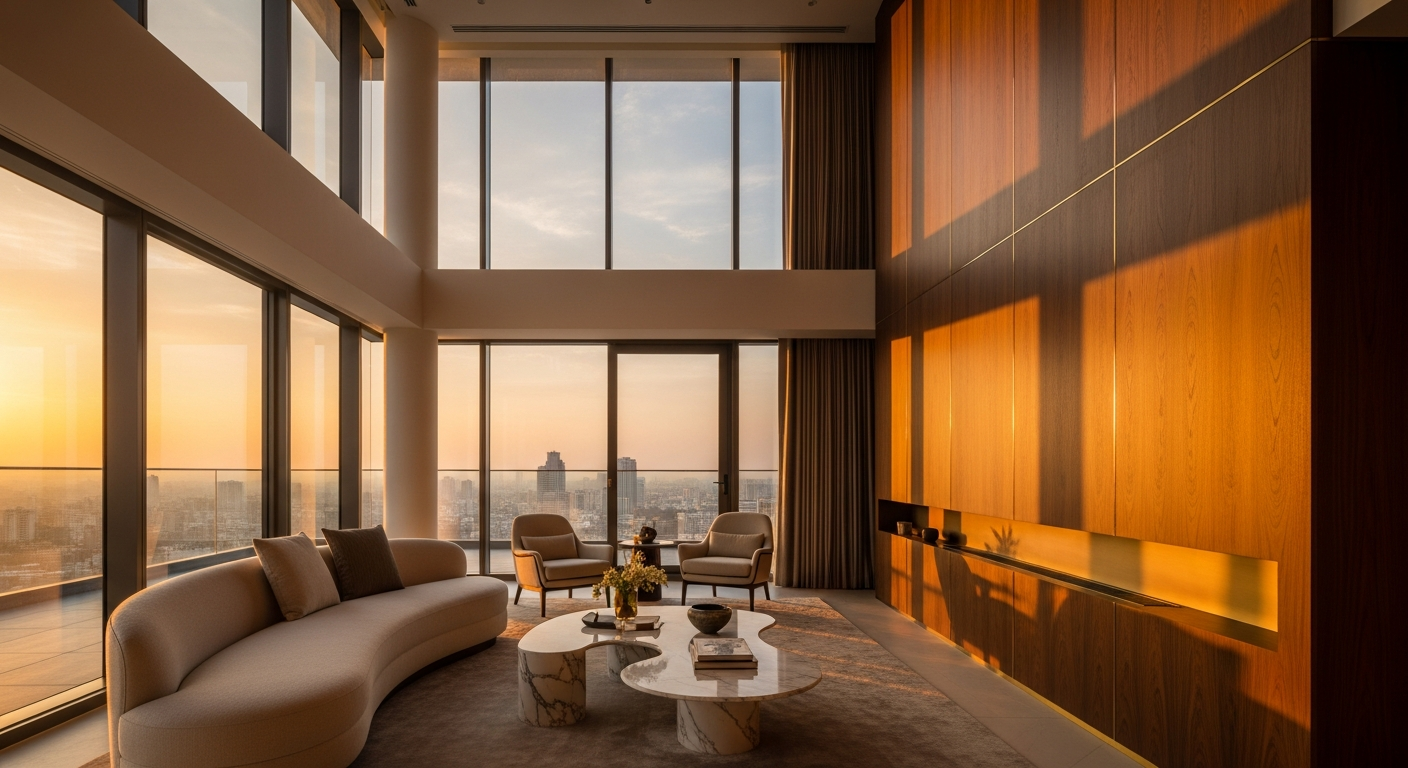
A penthouse is not a large apartment. It occupies a different structural, architectural, and experiential category — and its interior design must recognise this distinction from the first sketch to the final installation. The principles that guide a well-executed 3BHK interior are necessary but insufficient for a penthouse. What changes, and why, is the subject of this piece.
Scale Changes the Rules
The most immediate difference in a penthouse interior is scale. Floor plates of 3,200–6,000 sq ft are not simply larger apartments — they permit spatial arrangements, furniture groupings, and architectural gestures that are physically impossible in smaller properties. A living room that can accommodate a full conversation grouping with room to circulate comfortably, a dining space that seats twelve without compression, a kitchen with an island counter and a separate preparation zone — these are not configurations possible in any apartment below this scale.
Scale creates both opportunity and obligation. The opportunity is spatial generosity — rooms that breathe, corridors with presence, volumes that feel curated rather than filled. The obligation is to design for that scale rather than simply placing apartment-sized furniture in larger rooms. A sofa appropriate for a 1,200 sq ft apartment living room floats, unanchored, in a penthouse living area of 500 sq ft. The furniture, the rugs that anchor zones, the lighting fixtures, the ceiling treatment — all must be calibrated for the room's actual proportions.
Panoramic Views Demand Restraint
Penthouses in Bangalore's well-located towers command views that form the primary design asset of the property. The Nandi Hills at dawn. The city grid illuminated at dusk. The green canopy of Sarjapur or the distant ridgeline toward Tumkur. These views should be the centrepiece of the interior experience — and the interior design's role is to frame them, not compete with them.
This principle of restraint is the defining characteristic of well-executed penthouse interiors. Heavy curtains that obscure the glazing, furniture positioned to face away from the view, ceiling treatments so elaborate they draw the eye upward rather than outward — these are design choices that work against the property's central asset. The finest penthouse interiors are those where every seated position in the living space, every waking moment in the master suite, and every meal at the dining table is oriented toward the view rather than away from it.
Material selections follow this logic. Interiors with too many competing finishes — five wood tones, four tile patterns, three distinct colour families — create visual noise that fights the view. A disciplined palette of two or three materials in high quality lets the space breathe and makes the view feel intentional rather than incidental.
The Duplex Staircase as Architectural Element
Many penthouses in Bangalore are duplex configurations — the primary living spaces on the lower level, the master suite and private spaces on the upper level, connected by an internal staircase. This staircase is not a functional afterthought. In a penthouse, it is a sculptural commission.
A penthouse staircase must be designed with the same deliberateness as a piece of furniture — the profile of the railing, the thickness and material of each tread, the treatment of the soffit and the wall beside the stair, the landing design that receives residents at the upper level. Glass balustrades with brushed brass hardware, stone treads in the primary floor material, and a floating soffit with linear lighting are one considered vocabulary. Solid hardwood treads with a slender black steel railing and a gallery-lit artwork wall on the adjacent face is another. Both are coherent. Neither belongs in an apartment; both belong here.
Double-Height Spaces
Where penthouses include double-height living volumes — a common configuration in premium developments — the design challenge is vertical. A standard 9-foot ceiling height permits two-dimensional thinking: walls, furniture, and floor define the room. A double-height space of 18–22 feet creates a vertical dimension that must be designed as actively as the floor plan.
Curtain treatments for double-height glazing — motorised, given the impracticality of manual operation at height — must be specified for the full opening, not to a standard dropped ceiling position. Pendant lighting, whether a single commissioned fixture or a cluster composition, must be scaled to the vertical volume and positioned at a height that serves both ambient illumination and spatial proportioning. Feature walls at double height require materials or treatments that read at a distance — oversized stone slabs, continuous vertical panelling, or a curated artwork arrangement scaled to the wall's dimensions.
The Shift in Material Grade
Penthouse interiors at Nexus Living Hub are delivered at Premium and Elite tiers exclusively. This is not a commercial decision — it is an architectural one. The material grade that defines a penthouse interior has specific requirements: kitchen shutters in veneer or PU finish, natural stone or premium engineered wood flooring, Hettich or Blum hardware throughout, and custom joinery profiles rather than standard catalogue module configurations. These choices are not interchangeable with those of a lower-specification project.
Elite-tier materials — veneer in matched grain patterns, solid surface countertops, solid hardwood details — age with the property in a way that laminate and acrylic do not. A penthouse purchased as a long-term asset deserves interior materials selected on the same timescale.
Smart Home Integration
In a penthouse of significant square footage, the argument for smart home integration moves from preference to practical necessity. Lighting scenes — a curated configuration of ambient, task, and accent lighting activated with a single command — transform the experience of entertaining and of everyday living. Motorised curtains across double-height glazing are a functional requirement, not an indulgence. Climate control zoned by floor avoids the inefficiency of conditioning the entire property when only one floor is occupied.
All smart home wiring — Ethernet, control wires, speaker cabling — must be planned and installed during the construction phase. Retrofitting these systems after fitout involves significant disruption and invariably compromises the finished quality. The conversation about smart integration belongs in the first design brief, not the last.
Planning a penthouse interior that honours the property's character?
Frequently Asked Questions
An Essential-tier finish in a 3,200–6,000 sq ft penthouse creates a mismatch between the property's architectural quality and its interior execution. Penthouses are built with higher slab heights, superior structural specifications, and materials throughout the building's construction that signal a certain standard. An under-specified interior diminishes rather than enhances this. The Premium and Elite tiers are calibrated to the material and scale expectations that a penthouse represents.
In a penthouse of significant square footage, manual control of lighting, curtains, climate, and security becomes genuinely inconvenient. Smart home integration — scene-based lighting, motorised curtains in the double-height living room, centralised climate control, video door systems — moves from a luxury addition to a functional necessity. Wiring and network points for smart systems are infinitely easier to plan at the design stage than retrofit after fitout.
A penthouse interior of 3,200–6,000 sq ft typically requires 75–90 days from BOQ sign-off to handover, depending on scope complexity, custom fabrication lead times, and the degree of bespoke joinery involved. Projects with commissioned furniture, imported materials, or extensive smart home integration may run longer. Early planning before possession substantially reduces the post-possession construction period.