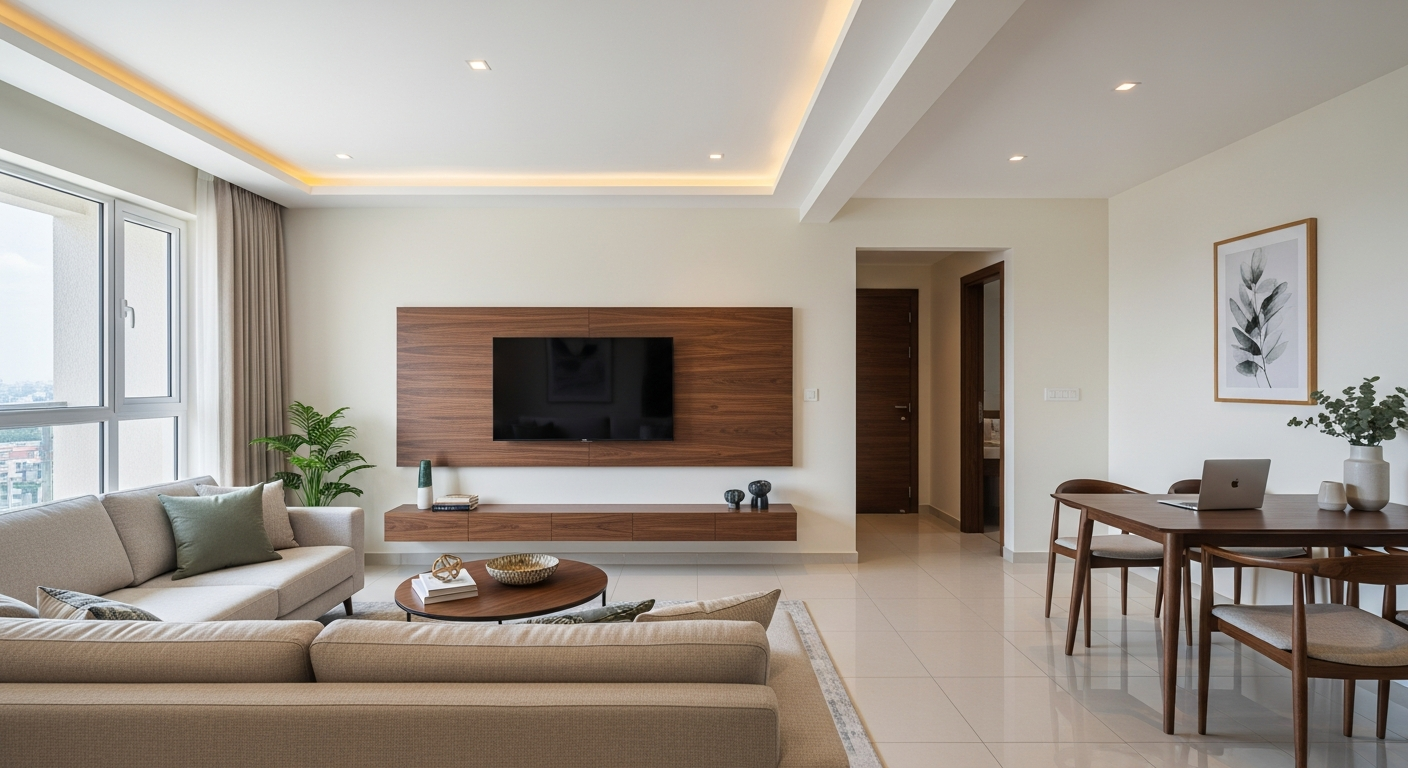
For non-resident Indians planning a Bangalore home from abroad, the interior project presents a specific set of challenges that resident homeowners don't face: a different time zone, the inability to physically review materials, dependence on others for site supervision, and a compressed window for in-person presence. This guide addresses each of these realities directly — and explains how a well-structured turnkey engagement makes the remote management of an interior project genuinely achievable.
The NRI Interior Challenge
NRI homeowners in Bangalore typically fall into one of two situations. The first: they have purchased a property as a future residence — a place to return to when their time abroad ends — and want it ready when they arrive. The second: they have inherited or purchased a property for immediate family members in Bangalore and want it completed to a quality standard they can trust without being present to enforce it.
In both cases, the core challenge is control. Interior design involves hundreds of decisions — materials, finishes, hardware, colours, layouts, electrical positions — and the quality of the outcome depends on those decisions being made correctly and executed faithfully. Without physical presence, this control must be delegated. The question is to whom, and under what accountability structure.
Why Turnkey Is Non-Negotiable for NRIs
A piecemeal approach to interior execution — engaging separate contractors for civil work, carpentry, painting, electrical, false ceiling, and furnishing — requires daily coordination across multiple independent parties, each with their own timelines, priorities, and accountability structures. When the property owner is in a different time zone, this coordination either falls on a family member who may lack the technical knowledge to supervise effectively, or it simply doesn't happen with any reliability.
A turnkey engagement changes the accountability structure fundamentally. One contract covers the entire scope. One project manager owns the entire timeline. One escalation point handles every issue. When a problem arises — a material delay, a site discrepancy, a contractor coordination failure — there is one party responsible for resolving it, and that party cannot redirect blame to someone else in the chain.
For NRIs, this single-point accountability is not a preference — it is the only viable model for managing a project remotely. Any other structure requires a level of hands-on supervision that is impossible at a physical distance.
The Remote Design Workflow
A well-structured remote design process follows a predictable sequence of milestones, each of which can be completed through video consultation, shared documents, and digital approval.
Initial consultation: Video call with the designer — walkthrough of the flat layout (shared digitally or via builder drawings), discussion of the brief, lifestyle, priorities, and reference images. This requires no physical presence. A 90-minute call is sufficient for a full initial brief.
3D visualisation: The most important remote review stage. The 3D renders show the complete layout, material selections, ceiling treatments, and furniture arrangement for every room. Review these with the designer on a shared screen call. This is the stage at which all significant design decisions are made — changes at 3D stage are free and immediate; changes during production are costly and time-consuming. Take this stage seriously.
Material selection: This is the one stage where physical presence is genuinely valuable. Materials — laminate textures, tile finishes, paint tones, hardware samples — look and feel different in person than on a screen. If you can plan a brief visit to Bangalore during the material selection window, this is the highest-value moment for your presence. Alternatively, your designer can physically visit showrooms and courier samples to you. This is slower but workable.
BOQ sign-off: The Bill of Quantities is a line-by-line cost document. Review it carefully against your brief and the 3D designs. This document defines your contract. Any scope changes after this point are variations — they carry a cost implication. Approve it only when you are satisfied that every element is correctly specified.
Site progress updates: During production and installation, request weekly photo or video updates at each stage. A responsible project manager provides these without being asked. The milestones to request specifically: false ceiling first fix, carpentry installation (before painting), painting completion, final fitout, and pre-handover walkthrough.
The Local Representative
The single most important practical decision for any NRI managing an interior project remotely is appointing a local representative — a trusted family member, friend, or professional who can make occasional site visits at key milestones and provide an independent view of progress quality.
This representative doesn't need technical expertise. Their role is presence and reporting: to physically walk the site at agreed intervals, take photographs, and report honestly on what they see. A parent, sibling, or trusted colleague in Bangalore can serve this role. Brief them on what to look for: is the ceiling work clean? Are wardrobe shutters installed without visible gaps? Is the painting consistent and without patches?
The representative is a check, not a substitute for the project manager's accountability. Their role is to give you an independent view and flag anything that concerns them so you can raise it directly with the firm.
Timeline Planning for NRI Projects
NRI interior projects often have an additional constraint: the homeowner wants the property ready for an India visit — a specific date window when they will arrive, inspect the home, and take possession. Planning backward from this date is the correct approach.
A 4BHK interior project runs 55–75 days from BOQ sign-off. Add 2–3 weeks for the design and brief phase, and another week for material selection. Starting the process 3–4 months before your target possession date gives a workable buffer for delays. Starting 6–8 weeks before your visit does not — and the pressure of an immovable deadline produces rushed decisions and quality compromises.
If you receive possession and are not able to return to India for 4–6 months, use that window to complete the entire design and approval process remotely, book your project slot, and have the full interior completed and ready for your arrival. A turnkey firm can coordinate possession logistics with the builder on your behalf.
Payment Structure and Documentation
Payments for Indian interior projects by NRIs are made in Indian Rupees from NRE or NRO accounts directly to the interior firm's Indian bank account. These transactions are standard banking operations — no special permission is required for interior services. Ensure every payment is accompanied by a GST-compliant invoice from the firm. These invoices are important documentation for property records and any future resale or dispute resolution.
The standard four-milestone payment structure — booking advance, design/BOQ approval, pre-installation, and post-handover — applies to NRI projects exactly as it does to resident projects. Never pay 100% upfront, regardless of who requests it. The retention held until handover is your only financial leverage if the project requires a snagging resolution.
Planning your Bangalore interior from abroad? We'll handle everything.
Frequently Asked Questions
Yes. With a full-service turnkey firm, the design consultation, 3D visualisation approvals, material selection, production, site execution, and handover can all be managed remotely with a local representative on your behalf. You will need to be available for scheduled video calls at key approval milestones — design sign-off, BOQ approval, material selection review, and handover walkthrough (ideally in person). If an in-person visit is possible at any one of these stages, material selection and the design sign-off are the highest-value moments for physical presence.
NRIs can make payments from NRE (Non-Resident External) or NRO accounts directly to the interior firm's Indian account. These are standard banking transactions and require no special permissions for residential interior services. A legitimate interior firm will provide GST-compliant invoices at each payment milestone, which can be retained for property tax and resale documentation. Avoid any arrangement involving cash or undocumented transactions.
A piecemeal approach — separate contractors for civil, carpentry, painting, electrical, and furnishing — requires someone with local knowledge, availability, and authority to coordinate all parties daily. When you're in a different time zone, this coordination falls either on an unavailable family member or it simply doesn't happen reliably. A turnkey firm accepts single-point responsibility: one contract, one project manager, one point of escalation. This is not a preference for NRIs — it is the only workable model when the owner is not physically present.
A professional turnkey firm provides regular photo and video updates at each construction phase — raw work, first fix, false ceiling, carpentry installation, painting, and final fitout. These are shared via WhatsApp or email on a scheduled basis. Additionally, your appointed local representative (a family member or trusted contact) can make site visits at agreed intervals to confirm progress. At Nexus Living Hub, our project managers are directly accessible to clients and provide weekly progress reports throughout the project.