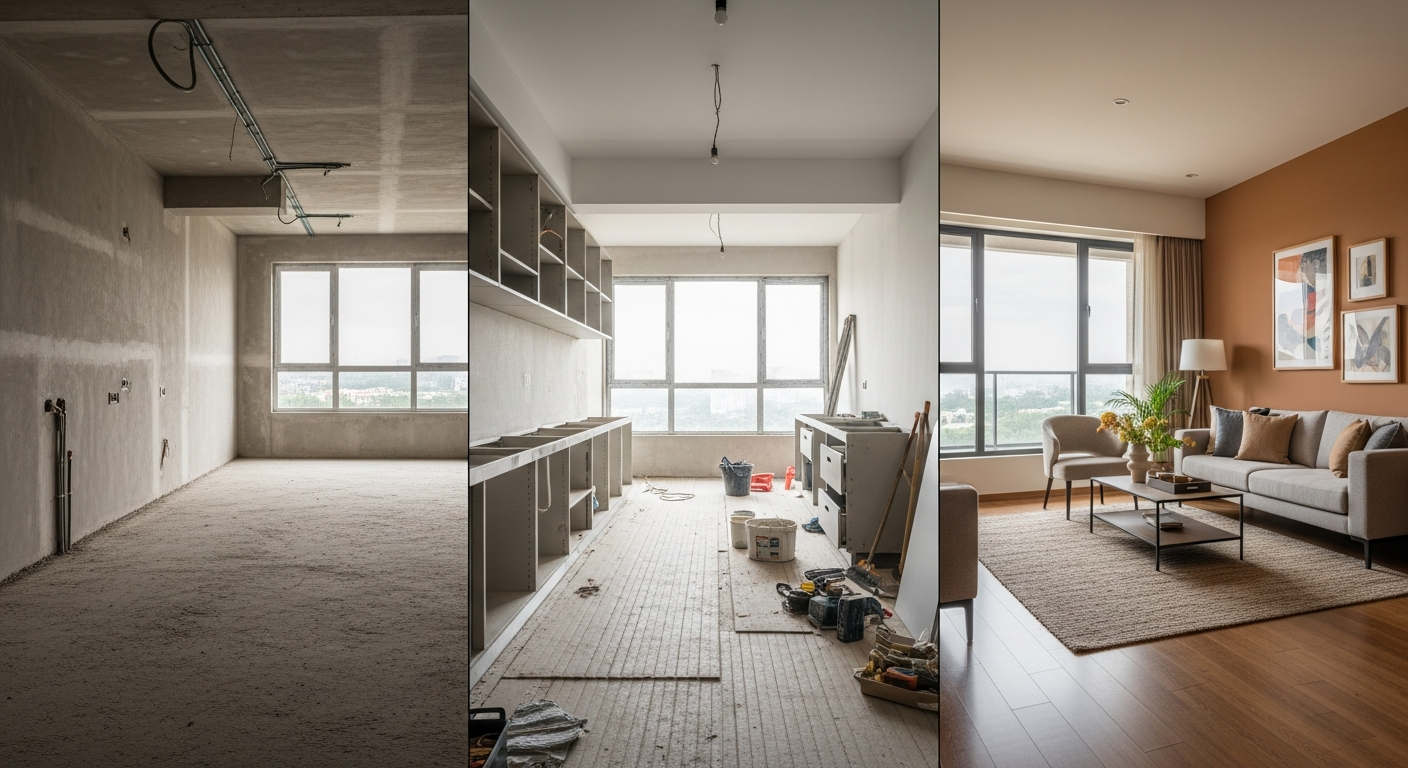
A well-managed interior project isn't a continuous blur of activity — it moves through defined milestones where decisions are made, approvals are given, and the project advances to the next stage. Understanding what each milestone means helps you know what to expect, when your input is needed, and what the payment triggers are. Here's a walk through all seven milestones of a Nexus Living Hub project.
Milestone 1 — Free Site Visit and Consultation
What happens: The designer visits your site, conducts a full walkthrough, takes notes on the brief, and shares an initial scope estimate within 3–5 working days. The estimate covers three package tiers so you can see what different investment levels look like for your specific flat and requirements.
What you need to do: Review the proposal, ask questions, and decide whether to proceed. There is no payment at this stage — this milestone is entirely free.
What to watch for: The estimate should be specific enough to show what's included and what's not. If it's a single number with no line items, ask for a breakdown before proceeding. See the first consultation guide for full detail on this stage.
Milestone 2 — Booking (10% of Project Investment)
What happens: You decide to proceed. The 10% booking amount is received, your project slot is confirmed in the production schedule, and the full design team is assigned. The detailed design process begins.
What you need to do: Sign the project agreement, confirm the booking amount, and participate in the detailed brief collection — a longer, structured conversation covering every room in detail.
What to watch for: The booking amount is a commitment to proceed. Take the time you need to evaluate the proposal before reaching this milestone — the consultation phase has no commitment at all. Only book when you're genuinely ready to go forward.
Milestone 3 — Design Development and 3D Visualisation
What happens: Detailed floor plans, ceiling plans, wardrobe layouts, kitchen layout, and all room-by-room designs are developed. Then the approved plans are rendered into photorealistic 3D visuals — typically one per major space. These are shared for your review and approval.
What you need to do: Review the 3D renders seriously (see our 3D visualisation guide). Provide consolidated feedback. This milestone typically runs 1–2 revision rounds. Approve the final design clearly — this is the design freeze.
What to watch for: Don't rush this stage. This is the last free checkpoint — every change requested here costs nothing. Every change requested after production begins costs real money and time.
Design approval — the most important decision gate in the project, and the last point where changes are free.
Milestone 4 — Material Selection and BOQ Approval (50%)
What happens: You visit the experience centre (or review physical samples) to select all materials: kitchen finish and countertop, wardrobe shutters, hardware, flooring, and paint palette. The final Bill of Quantities — itemised cost breakdown for every element — is prepared and shared for your review. Once approved, the 50% second payment is triggered.
What you need to do: Make material selections decisively — procurement is scheduled immediately after BOQ approval. Review the BOQ carefully: check that every element you discussed is listed with the specification you agreed on. Ask about anything that's unclear. Sign off on the BOQ only when you're fully comfortable with what's in it.
What to watch for: The BOQ sign-off is the production trigger. Vague line items or items with unspecified grades should be clarified now — "as discussed" in a BOQ is not a meaningful specification. See our BOQ guide for what a complete BOQ should contain.
Milestone 5 — Production
What happens: All modular cabinetry — kitchen, wardrobes, TV unit, and all fixed furniture units — is manufactured in the factory. Materials are procured and delivered to the production facility. Quality checks happen before anything leaves for site. In parallel, the site is prepared: civil work, electrical rough-in, painting, and flooring are completed so the site is ready to receive carpentry.
What you need to do: Site preparation. If you or family are managing any civil work independently, this period is when it needs to happen. Carpentry installation cannot begin into a site where painting is incomplete or flooring is not laid.
Milestone 6 — Site Installation
What happens: Factory-produced cabinetry arrives at site and is installed. Hardware is fitted. Loose furniture is delivered and placed. The project manager tracks progress daily, coordinates trades, and communicates status to you regularly.
What you need to do: The 30% third payment is triggered when production is complete and materials are ready for delivery. Ensure site access is available throughout — installation requires consistent access across the work period.
Milestone 7 — Snagging Walk, Handover, and Final Payment (10%)
What happens: Before the client walkthrough, the project manager conducts a structured snagging walk — a room-by-room quality check against the approved design and BOQ. All deficiencies are documented and resolved. You then join for the client walkthrough: every element is tested and checked together. Any remaining items go on a punch list with committed resolution timelines. The final 10% payment is due at handover sign-off.
What you need to do: Take the walkthrough seriously. Open every drawer, test every hinge, check every painted surface, and look at every junction. This is your last structured review before moving in. Anything not raised now is harder to address after the project is closed.
For the broader schedule around these milestones, see the week-by-week project timeline. For budget planning that maps to these payment milestones, see the interior budget guide. For what a strong proposal looks like before milestone 2, see our designer evaluation guide.
Start Milestone 1 Today — Free, No Commitment
Book a free site visit. No charges, no obligation — just a conversation about your home and what it could be.
Frequently Asked Questions
Changes after BOQ sign-off are treated as variations — additions or modifications to the agreed scope that carry their own cost and, potentially, schedule impact. A simple addition (adding a pull-out tray to an already-designed wardrobe) has a modest cost. A structural change (moving a wardrobe to a different wall after the carcass is already in production) has a larger cost and delays that specific item. Changes after installation begins are the most expensive and disruptive. The BOQ review milestone exists precisely so that all changes can be made before production — at zero additional cost.
The snagging walk checks every element against the approved design and BOQ: all hardware functions correctly (soft-close hinges, drawer channels, door handles), all painted surfaces are smooth and consistent, all floor tiles are level and grouted, all false ceiling joins are clean, all electrical fittings are seated correctly, all wardrobe internals are as specified, and all loose furniture is correctly placed. Any item that doesn't meet specification goes on a snagging list with a committed resolution date — typically within 3–7 days. Handover happens only after the snagging list is either resolved or formally documented with committed timelines.
The booking amount secures your project slot in the production schedule and formally starts the design process. It is a commitment to proceed — not a deposit you can freely withdraw. If you change your mind after booking, the booking amount may be partially or fully applied to cancellation costs, depending on how far the design process has progressed. This is why we encourage homeowners to take the time they need to evaluate proposals before booking — the free consultation phase has no commitment at all.