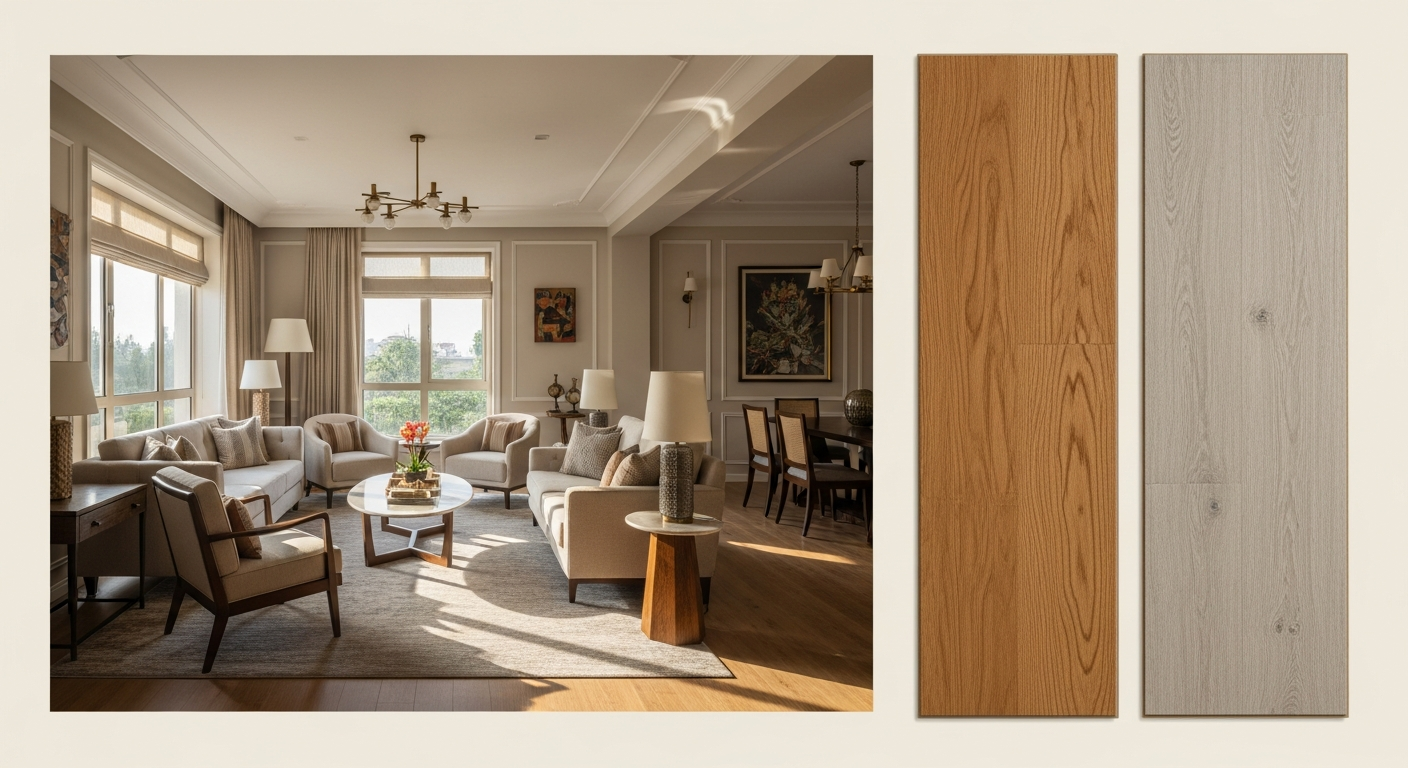
Flooring covers every square foot of your home and influences how every room looks, feels, and ages. Getting it right matters — not just aesthetically, but practically. Bangalore's climate is distinctly different from North India's heat or Mumbai's coastal humidity, and the flooring decisions that work well in those cities don't automatically translate here. This guide explains each major flooring category, how it performs in Bangalore's specific conditions, and which rooms it's best suited for.
Understanding Bangalore's Climate Context
Bangalore sits at approximately 900m above sea level, giving it a climate that is moderate year-round — neither the extreme heat of Chennai nor the extreme humidity of Kochi. Temperatures range from around 14°C (winter nights) to 35°C (April-May pre-monsoon peaks). The monsoon season (June–September) brings significant humidity and occasional heavy rainfall, which can affect open areas and poorly sealed interiors.
The practical implications for flooring: materials that expand and contract significantly with temperature changes are less of a concern than in North India, but moisture management during the monsoon months is relevant — particularly for wood-based materials in ground-floor units or homes with less effective ventilation. Material selection should account for this seasonal humidity variation.
Vitrified Tiles — The Workhorse
Vitrified tiles are the most widely used flooring material in Bangalore apartments, and for good reason. They are fired at high temperatures to produce a dense, non-porous surface that resists moisture, staining, scratching, and everyday wear. They are unaffected by humidity changes, require minimal maintenance, and are available in a range of sizes, finishes, and patterns.
For Bangalore homes, large-format double-charged vitrified tiles (600×600mm or 800×800mm) in matte or satin finish are the most practical and visually effective choice for living rooms, dining areas, corridors, and kitchens. Larger formats create fewer grout lines, making the floor easier to maintain and the space feel larger. Polished vitrified tiles look impressive when installed but show every footprint and pet paw in natural light — matte or satin finishes are more forgiving for daily living.
The weakness of vitrified tiles: they are hard underfoot (noticeable for families who spend time sitting on the floor), cold in winter mornings, and acoustically less comfortable than softer materials — footsteps and dropped objects are louder. For bedrooms, warmer flooring alternatives are worth considering.
Engineered Wood — Warmth with Stability
Engineered wood flooring consists of a real wood veneer bonded to a cross-ply HDF or plywood core. The core provides dimensional stability — resistance to the expansion and contraction that cracks solid hardwood planks in variable humidity conditions. In Bangalore's moderate climate, engineered wood performs well in bedrooms, living areas, and study rooms.
The visual warmth of engineered wood is its primary appeal — no other material provides the same combination of natural texture, acoustic softness underfoot, and visual richness. In a bedroom, waking up to engineered wood flooring rather than tiles is a meaningfully more comfortable experience, particularly in cooler months.
The practical constraints: engineered wood should not be installed in bathrooms, utility areas, or uncovered balconies. It requires a sealed subfloor and a moisture barrier underlay in ground-floor installations. It scratches more readily than tiles — relevant for pet owners or families with heavy furniture. And it carries a higher cost than vitrified tiles. These are trade-offs, not disqualifications.
Luxury Vinyl Plank (LVP) — The Practical Middle Ground
Luxury vinyl plank flooring has improved significantly in quality and visual authenticity over the past decade. Modern LVP products use photographic embossing to replicate wood grain, stone, and concrete textures with reasonable fidelity. They are 100% waterproof (unlike engineered wood), softer and quieter underfoot than tiles, and considerably easier to install — floating over an existing floor without adhesives.
For Bangalore homes, LVP is an excellent option for bedrooms, children's rooms, and utility areas where moisture tolerance and easy maintenance are priorities. It is not a substitute for the quality feel of real engineered wood or natural stone, but it is a practical and cost-effective flooring for rooms where those materials would be impractical.
Natural Stone and Marble
Natural stone — marble, limestone, granite, and slate — occupies the premium end of the flooring market. In a Bangalore villa or penthouse, natural stone flooring in the entrance, living area, or dining zone creates an architectural statement that no manufactured material replicates. The variation within each slab, the cool touch underfoot, and the way stone ages with use give it a quality that only improves over time when maintained correctly.
The maintenance requirements are the primary deterrent. Marble is porous — it stains with turmeric, oil, red wine, and acidic cleaners unless sealed annually and cleaned promptly. Granite is harder and less porous but still requires some care. For Indian households with active daily cooking and children, natural stone in the kitchen is rarely the right choice. In the living area, entrance, and formal dining zone — spaces where the aesthetic impact is highest and the abuse is lower — natural stone makes excellent sense.
Flooring Comparison: Room-by-Room at a Glance
The table below summarises each major flooring type across the key factors that matter for Bangalore homes:
| Flooring Type | Durability | Moisture Resistance | Maintenance | Warmth Underfoot | Relative Cost | Best Rooms |
|---|---|---|---|---|---|---|
| Vitrified Tiles | Living, Kitchen, Corridor, Bathrooms | |||||
| Engineered Wood | Bedrooms, Study, Living (dry areas) | |||||
| Luxury Vinyl (LVP) | Bedrooms, Children's Room, Utility | |||||
| Marble / Natural Stone | Entrance, Living, Dining (premium homes) | |||||
| Anti-Skid Tiles | Bathrooms, Balcony, Kitchen wet zone |
Anti-Skid Tiles: Non-Negotiable in Wet Zones
Bathrooms, wet kitchen zones, and uncovered balconies require anti-skid rated tiles — not standard vitrified tiles. Polished vitrified tiles in a bathroom become dangerously slippery when wet. Anti-skid tiles have a textured surface finish (sometimes described as matte, grip, or R-rated in European specification) that provides friction when wet.
The anti-skid specification matters most for elderly household members and young children. In India, bathroom falls are among the most common home accidents — and the vast majority occur on polished tile. Specifying the correct anti-skid tile at the design stage is a safety decision that costs nothing extra compared to a standard tile of equivalent quality.
Recommendations by Room — Bangalore Context
Living and dining area: Large-format matte vitrified tiles (600×600mm or larger) in a warm beige, light grey, or stone-look pattern. These connect visually with the warm colour palette that works best in Bangalore's natural light. Consistent across living and dining to make the combined area feel spacious.
Kitchen: Same vitrified tile as the living area for visual continuity, with an anti-skid variant in the cooking zone (near the hob and sink) where spills and splashes are most likely.
Bedrooms: Engineered wood in a warm honey or mid-brown tone for the master bedroom — the warmth underfoot in Bangalore's cooler winter mornings is worth the premium. For children's rooms, quality luxury vinyl plank in a wood-look finish: waterproof, child-friendly, and easily maintained.
Bathrooms: Anti-skid ceramic or porcelain tiles, minimum R10 slip resistance rating. Large formats (400×400mm) work well in master bathrooms; smaller formats (200×200mm or mosaic) for compact bathrooms.
Balcony: Anti-skid outdoor-grade tiles that can handle rain exposure. Ensure the tiles have an R11 or R12 slip resistance rating for unprotected outdoor areas. Avoid indoor vitrified tiles on open balconies — they will deteriorate and become slippery when rained on.
Want flooring specifications designed for your specific rooms and lifestyle?
Frequently Asked Questions
Engineered wood is significantly more stable than solid wood in humid conditions — the cross-ply core resists the expansion and contraction that cracks solid wood planks during humidity changes. For Bangalore's moderate humidity (which rises during the June–September monsoon), engineered wood with a proper moisture barrier underlay performs well in bedrooms and living areas. Avoid engineered wood in bathrooms, balconies, and kitchen areas where standing water is possible. In well-ventilated rooms with good humidity management, engineered wood is a comfortable and durable flooring choice.
Large-format double-charged or glazed vitrified tiles in a matte or satin finish are the most low-maintenance flooring for Indian homes. They require only sweeping and mopping, resist staining, are unaffected by humidity, and last indefinitely without refinishing. The key to easy maintenance is large formats (600×600mm or 800×800mm) — fewer grout lines mean fewer areas where dirt accumulates. For bedrooms, luxury vinyl planks are the second-most low-maintenance option, with similar cleaning requirements and additional comfort underfoot.
Not necessarily — but a cohesive material language matters. A common approach: a consistent tile type and tone in the living, dining, kitchen, and corridor (creating the impression of a larger connected space), transitioning to a warmer material (engineered wood or quality vinyl) in the bedrooms (for comfort underfoot when waking), and a separate anti-skid tile specification for bathrooms and the kitchen cooking zone. The transitions between materials should be managed with threshold strips or a deliberate design junction rather than an abrupt change.