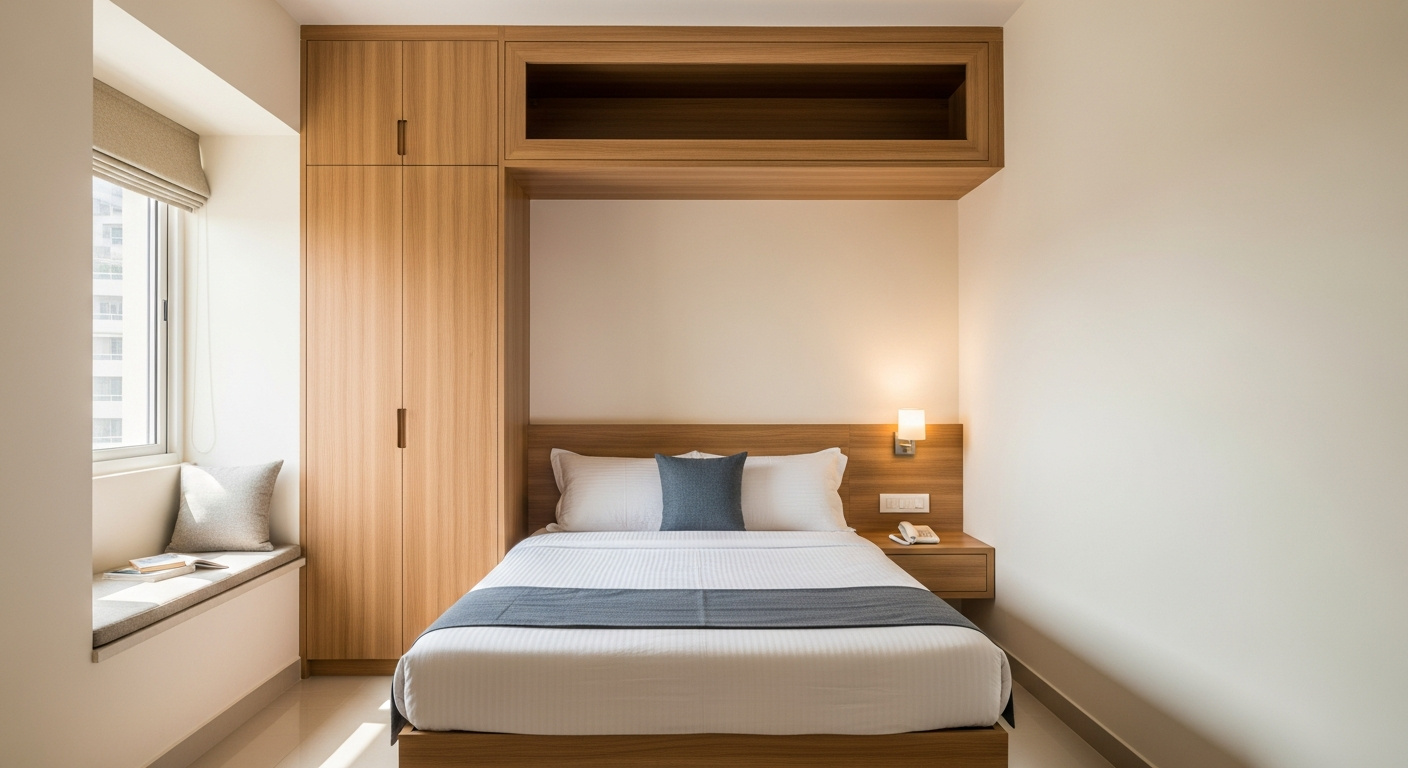
Bangalore's compact apartment bedrooms — 10x10ft, 10x12ft, the occasional 10x14ft — can feel perpetually short on space. But most of them aren't short on space; they're short on planned storage. The difference between a bedroom that feels cramped and one that feels calm and spacious is almost always how storage was designed, not how big the room actually is.
Smart storage doesn't mean more furniture. It means fewer, better-designed pieces that work harder — and it means thinking vertically, not just horizontally.
Full-Height Wardrobes with Loft
The single highest-impact storage upgrade available in any bedroom. A standard builder-provided or furniture-store wardrobe is typically 6–7 feet tall, leaving 2–3 feet of ceiling space above it completely unused. Building the wardrobe to the ceiling — typically 9 feet in Bangalore apartments — adds 30–40% additional storage in the loft section without increasing the wardrobe's floor footprint by a single inch.
The loft section stores seasonal items (extra blankets, heavy winter clothing, unused luggage), rarely-accessed documents, and guest bedding. It should have separate shutters from the main wardrobe body so access doesn't require clearing the lower sections. The loft is not everyday storage — it's overflow storage that would otherwise occupy floor space.
Critically: a floor-to-ceiling wardrobe also improves the room's visual proportions. The vertical line of the full-height unit draws the eye upward, making the ceiling feel higher. A standard-height wardrobe with dead space above it has the opposite effect — it makes the ceiling feel lower and more oppressive.
Internal Wardrobe Organisation
Most wardrobes — including many professionally built ones — waste internal space with generic layouts: two horizontal shelves and a hanging rod. The actual clothing needs of most Bangalore families are more specific than this, and a custom internal layout recovers significant usable space.
Start by taking stock of what goes in the wardrobe. Saree storage requires full-length hanging (60+ inches clearance) or flat-stack shelves 12–14 inches deep. Daily shirts and trousers work well on a double-rod arrangement — two rods stacked, one at 40 inches and one at 80 inches, doubles the hanging capacity in the same vertical space. Folded items belong on adjustable shelves. Undergarments and accessories belong in drawer modules, not on shelves where they fall out and create visual chaos.
Pull-out accessories — tie and belt hooks, watch trays, jewellery inserts — are small additions that make the wardrobe genuinely functional rather than just storage. The additional cost is modest relative to the daily-use improvement.
Under-Bed Storage
A standard bed with no under-storage is a missed opportunity. The space under a queen-size bed is approximately 24–36 cubic feet — roughly the same volume as a medium wardrobe section. A platform bed with a hydraulic lift mechanism uses all of this volume for flat storage: bedsheets, blankets, light luggage, and out-of-season clothing.
The alternative is a drawer-base bed — individual drawers on each side. Drawers provide easier access to smaller items stored frequently (the two bedroom drawers typically replace two bedside table drawers each). The trade-off: drawer depth limits what can be stored, and the drawers require floor clearance to pull out.
Both options occupy exactly the same floor space as a standard bed. The storage they provide would otherwise require additional furniture — a chest of drawers, an extra wardrobe unit — that takes floor space and makes the room feel smaller.
A hydraulic lift platform bed — all under-bed space used for storage, zero floor clutter visible.
Wall-Mounted Solutions
Every piece of furniture that sits on legs uses floor space twice: once for its own footprint, and once for the visual weight of the legs and clearance beneath it. Wall-mounted equivalents eliminate both.
Floating bedside tables: Wall-mounted bedside shelves or a slim floating unit at bed height. The floor below is completely clear, making the room feel significantly more open. The shelf takes up less visual space than a floor-standing table and is easier to clean around.
Floating shelves above desk area: In bedrooms with study corners, floating shelves above the desk (at 18 inches above the desk surface and above) keep books and materials accessible without floor-standing bookcases.
Pegboards for daily accessories: A wall-mounted pegboard near the wardrobe area handles bags, scarves, belts, and frequently-used accessories that don't belong in the wardrobe but tend to accumulate on chairs and door handles.
Corner Utilisation
The corners of a bedroom are the most consistently underused areas. An L-shaped corner shelf unit, mounted at eye level in one corner, provides significant shelf space without protruding into the room on a single wall. Corner wardrobe modules — available from most modular manufacturers — use the corner space that standard flat-panel wardrobes cannot reach, adding internal volume to an existing wardrobe without increasing its external footprint.
In bedrooms with study needs, an L-shaped corner desk that wraps two walls uses corner space productively while providing more desk surface than a single-wall desk of the same cost.
The Two Principles Behind All Good Bedroom Storage
Principle 1 — Everything must have a designated place. The reason bedrooms accumulate clutter is not too many possessions — it's that too many objects have no home. A pile of clothes on a chair means there was no designed place for those specific items. Every object you own should have a planned storage location; objects without locations always become visible clutter.
Principle 2 — Vertical space is free real estate. Walls above head height — from about 6 feet to 9 feet — are completely unused in most bedrooms. In a room with 80 square feet of floor area, there are approximately 240 square feet of wall area. The upper third of the walls (from 6 feet to 9 feet) represents 80 square feet of additional storage surface. Loft wardrobes and wall-mounted high shelving use this space productively.
These principles apply equally to other rooms — our balcony design guide applies the same thinking outdoors. For bedroom storage that goes beyond the standard wardrobe, our walk-in wardrobe guide covers when a walk-in makes sense and how to plan one. For the choice between sliding and hinged wardrobe doors — a decision that significantly affects usable floor space — see our wardrobe door guide. And if you're planning a 2BHK interior design, storage planning is one of the most important areas we focus on — compact spaces need every storage decision to be right.
Design Storage That Makes Your Bedroom Feel Bigger
Our team plans every bedroom storage solution as part of the full interior design. Book a free consultation to start planning your home.
Frequently Asked Questions
Yes — the key is using vertical space and wall-mounted solutions rather than adding freestanding furniture. A full-height wardrobe from floor to ceiling stores 40% more than a standard 7ft unit but occupies exactly the same floor footprint. Under-bed storage, wall-mounted shelves, and wall-mounted bedside tables add substantial storage without taking any additional floor space.
Hydraulic lift: easier to access, stores large flat items (bedsheets, blankets, suitcases), entire storage area visible at once. Drawer bed: better for items you need more frequently, no need to lift the mattress, but individual drawers limit the size of items stored. Both work well — the choice depends on what you're primarily storing and how often you need to access it.
22 inches (560mm) depth handles standard hanging and shelving. The more important consideration in a small bedroom is door type: sliding doors require no swing clearance, saving the 2-foot arc that hinged doors need. In a small bedroom, specifying sliding wardrobe doors instead of hinged ones often makes the difference between a comfortable room and an awkward one.