The open-versus-closed kitchen debate is the most emotionally charged discussion in Indian interior design. It touches cooking culture, family dynamics, smell management, social habits, and practical daily realities. There is no universally right answer — but there is a right answer for each family. Understanding the real trade-offs helps you decide with clarity rather than defaulting to either trend or tradition.
The Case for an Open Kitchen
The appeal of an open kitchen is visual and social. When the kitchen opens into the living and dining area, the space feels larger — dramatically so in apartments where the combined floor area creates a genuine sense of volume. The cook isn't isolated; conversations continue from kitchen to living room. Morning routines are more connected.
For couples without elderly parents, for those who cook lighter meals with less frying, for those who entertain frequently — the open kitchen is genuinely the better choice. It makes the kitchen a participatory space rather than a service area, which reflects how many younger Bangalore families actually live.
The aesthetic benefit is real too. A well-designed modular kitchen becomes part of the living room composition when it's open. The kitchen shutters, countertop, and backsplash contribute to the overall visual language of the home. In apartment living where every square foot matters, this architectural integration is an advantage.
The Case for a Closed Kitchen
Indian cooking generates smoke, oil vapour, and aromatic compounds at a scale that most open kitchens struggle to manage. A Sunday meal of tadka dal, fried pappadums, and fish curry in an open-plan apartment will scent every fabric in the living room — the sofa, curtains, and rugs absorb smells that don't dissipate quickly.
Beyond smell, there's mess. Indian cooking involves continuous motion between multiple burners, multiple vessels, and scattered ingredients. The prep area, the wet zone around the sink, and the heat zone around the stove all generate visible clutter during cooking. A closed kitchen contains this reality; an open one puts it on display.
For joint families with elderly parents, the privacy and noise separation of a closed kitchen matters. For households with domestic help where cooking happens while family members are in the living area, the separation is both practical and culturally natural.
The Hybrid Solution — What Most Bangalore Families Choose
Approximately 45% of our clients choose the semi-open hybrid kitchen, and it's easy to understand why. The hybrid captures the visual benefits of an open kitchen while retaining the containment benefits of a closed one.
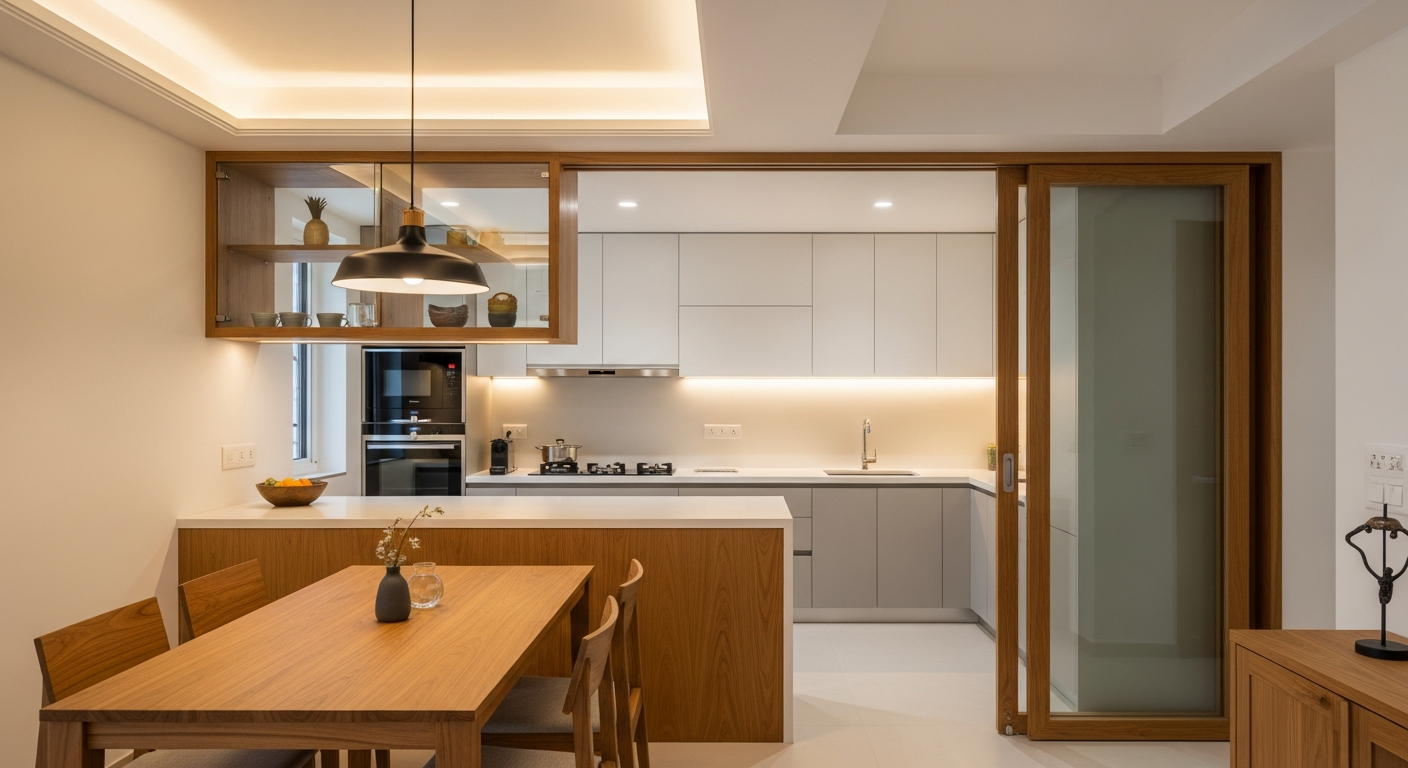
The most common hybrid execution: the kitchen opens at counter height to the dining or living area — creating the social connection and visual breadth — but sliding frosted glass panels or folding doors above the counter level allow the kitchen to be closed off during heavy cooking. When the panels are open, the space feels open. When they're closed, smells and mess stay contained.
A second hybrid approach uses a half-wall as a breakfast counter. The kitchen is nominally separate, but the counter-height opening allows visual and social connection without the full exposure of an open kitchen. This works especially well in U-shaped or L-shaped kitchen layouts where the counter edge faces the dining area naturally.
The kitchen opening framed with upper cabinets on either side creates structure — it looks designed rather than improvised. The framing of the opening is as important as the opening itself.
What Bangalore Apartment Layouts Allow
Most builders provide semi-open or closed kitchens in their standard layouts, with kitchen and living room separated by a wall with a serving counter or passage opening. Fully opening a closed kitchen usually requires removing a partition wall — feasible in most cases but requiring structural assessment. Conversely, closing a fully open builder kitchen requires adding a partition, which is always structurally simple.
Older apartment buildings (pre-2015) almost universally have closed kitchens. Newer apartment complexes, particularly in the 1,200+ sq ft 3BHK range from premium developers, often include semi-open or fully open kitchen layouts as a standard option.
The modification works both ways. If you want to open up a closed kitchen, a structural assessment during the site visit confirms feasibility — in most cases it's a non-load-bearing wall and the modification is straightforward. If you want to add separation to an open kitchen, this is always achievable with a partition wall, a glass panel system, or a heavy sliding door.
Ventilation Is the Deciding Factor
The one variable that makes or breaks an open kitchen for Indian cooking is ventilation quality. A high-capacity auto-clean chimney with 1200+ m³/hr suction, installed correctly with an exhaust route to the exterior, makes an open kitchen viable even for regular Indian cooking. Without it, no amount of good design compensates for oil vapour that deposits on your living room walls.
If you're committed to an open kitchen and cook Indian food regularly, budget for the best chimney you can afford. It's a functional investment that protects every other surface in your home.
What Our Clients Actually Choose
Across our 1200+ Bangalore projects: approximately 40% opt for a fully closed kitchen (joint families, elderly parents, heavy daily cooking). About 45% choose the semi-open hybrid with sliding panels or a framed counter opening. Around 15% go fully open — typically younger couples in smaller apartments with lighter cooking patterns.
The data confirms what the design logic suggests: the hybrid is the right answer for most Indian families. It's not a compromise — it's the solution specifically suited to the reality of Indian domestic life in a modern apartment.
For kitchen layout within whichever configuration you choose, our guide on L-shape vs U-shape vs parallel kitchen layouts covers how to maximise function. For 3BHK homes where the kitchen decision connects to the full apartment design, see our 3BHK interior design page. If you're considering an island counter as part of a semi-open layout, our island kitchen guide covers feasibility in Bangalore 3BHK apartments.
Not Sure Which Kitchen Layout Is Right for You?
Our team will assess your apartment layout, cooking habits, and family needs and recommend the right approach during a free site visit.
Frequently Asked Questions
Usually yes. A partition wall, a half-wall with glass above, or a sliding panel system can close an open kitchen effectively. We assess structural feasibility during the site visit — in most Bangalore apartments, the kitchen-living partition is a non-load-bearing wall, which makes modifications straightforward.
For an open kitchen with regular Indian cooking — tempering, frying, curries — we recommend an auto-clean chimney with a minimum suction capacity of 1200 m³/hr. Wall-mounted chimney hoods are more effective than island hoods for smoke capture in most apartment layouts. Specific brand recommendations are discussed during the material selection consultation.
Not negatively — in fact, open and semi-open kitchens are increasingly preferred in the Bangalore resale and rental market, particularly among young professionals and couples without elderly parents. The hybrid semi-open approach has the broadest market appeal because it can be opened or closed based on preference.