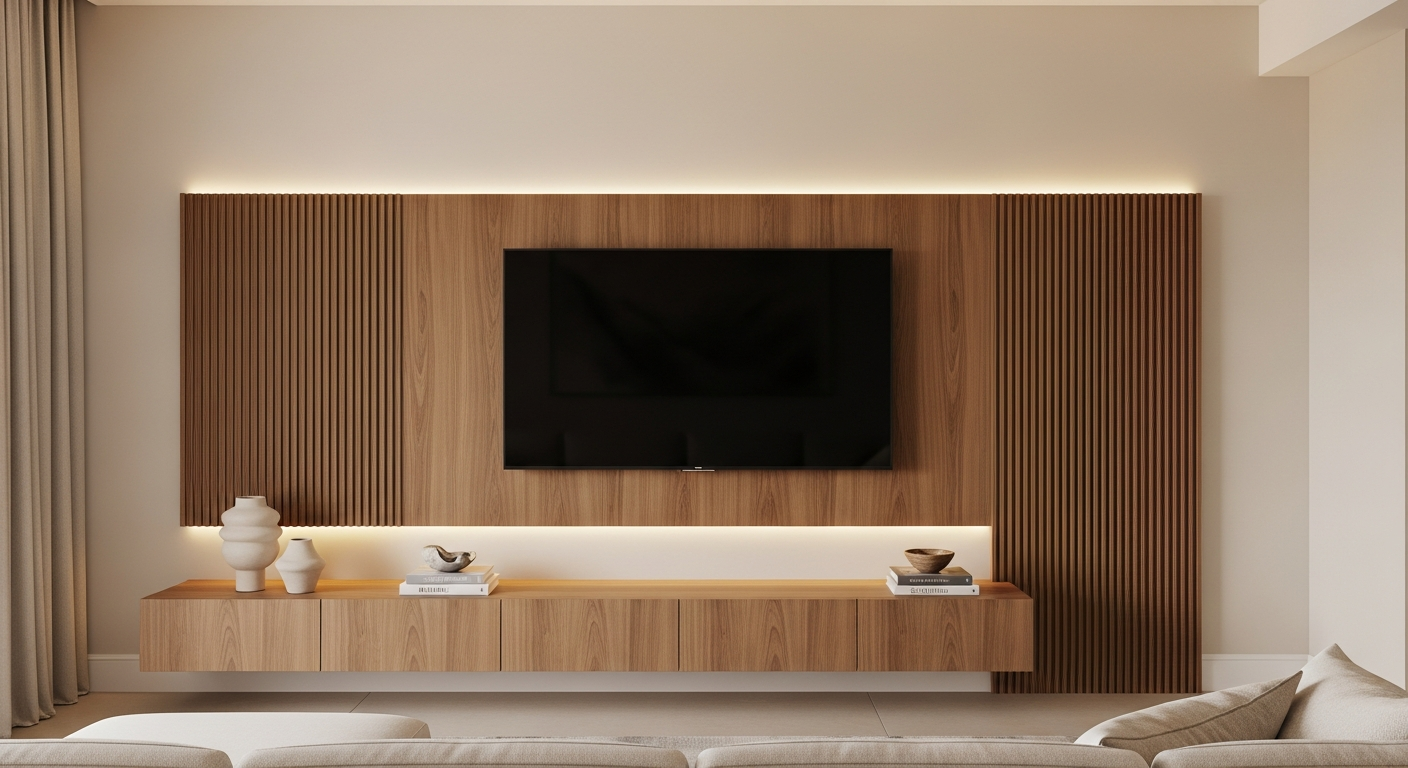
The TV wall is the most looked-at surface in any Indian home. Every evening, every conversation, every gathering happens facing it. It deserves better than a furniture-store rack with a tangle of cables visible behind it. A well-designed TV unit and feature wall transforms the entire character of your living room — and there's a right approach for every space size and budget tier.
Floating Console — The Minimal Choice
A wall-mounted horizontal unit with no legs is the clean slate of TV unit design. With the console lifted off the floor, the eye travels uninterrupted across the room, making the space feel larger than it is. This approach works exceptionally well in compact living rooms where visual weight at floor level creates clutter.
The floating console typically includes a main cabinet section for the set-top box, streaming device, and remotes, plus a floating shelf above for additional components or a single decorative object. Cable management routes behind the wall — this must be planned before the unit is fixed, not after.
The backdrop for a floating console can be a simple painted wall, a fluted panel section, or a full-wall treatment. The console itself is the primary element; the backdrop amplifies it.
Full-Wall Panelling — The Statement
Floor-to-ceiling panel treatment behind and around the TV is the most architecturally complete TV wall option. The TV is either recessed flush into the panel or surface-mounted against it. Floating shelves, display niches, and concealed storage are all integrated into the panel composition before finishing.
This approach works best in Premium and Elite projects where the living room has a clear visual ambition — when the TV wall is meant to be the design centrepiece. It requires precise planning: every cable conduit, every electrical point, every shelf position must be resolved in the 3D design before a single panel goes up. Changes after installation are expensive.
Material choice for full-wall panelling matters enormously. A veneer panel in warm oak with a matte finish reads as architectural and refined. A high-gloss lacquered panel reads as contemporary-luxe. A laminate panel in a wood tone is accessible and versatile. The panel should complement, not compete with, the rest of the room.
Fluted Panel Backdrop
Vertical fluted panels — MDF or wood with parallel ridges creating a textured, shadow-play surface — have become one of the most requested TV wall treatments in Bangalore living rooms. Their appeal is the combination of visual texture and ease of installation: fluted panels can be applied as a backdrop section rather than a full wall treatment, making them accessible across budget tiers.
The ridges catch light differently across the day, making the surface feel alive. The vertical rhythm draws the eye upward, adding perceived height. In warm neutral tones — natural oak, walnut, greige — fluted panels work beautifully in both warm minimal and contemporary styles. In high-gloss white or dark charcoal, they work in more dramatic, contemporary schemes.
Wooden Slat Wall
Where fluted panels offer texture through ridges, wooden slat walls offer depth through gaps. Horizontal or vertical wooden slats (typically 30–50mm wide) with spacing between them create an architectural rhythm. The gap between slats allows backlighting — an LED strip behind the slats creates a luminous glow effect when the room lights dim.
The slat wall is especially dramatic when it extends upward from the TV unit to the ceiling, effectively dissolving the boundary between wall and ceiling. The depth of the slats and the quality of the timber (or timber-finish material) determine whether this feels premium or generic. Real wood slats require finishing and periodic maintenance; engineered timber slats are more stable and consistent.
Combination Units — For Families With Real Storage Needs
A TV unit that combines display shelving, storage cabinets, a crockery or bar section, and the TV in a single wall-to-wall composition is the most practical choice for families. Rather than having multiple furniture pieces scattered across the living room, everything consolidates into one designed wall.
The composition can be symmetrical — identical shelving sections flanking the central TV — or asymmetric, which reads as more contemporary and editorial. Closed cabinets at lower levels keep daily clutter out of sight. Open shelves at upper levels carry books, curated objects, and plants.
This approach benefits most from professional design because the proportions — height-to-width ratios, shelf spacing, door size — determine whether the unit feels heavy and generic or light and tailored.
Vertical fluted panels create texture and shadow play — one of the most requested TV wall treatments in current Bangalore projects.
Choosing Based on Your Room Size
The decision is partly aesthetic and partly practical. In a small living room under 150 sq ft, a floating console with a fluted backdrop section keeps the visual weight light. Adding a full-wall combination unit in a compact room can feel oppressive. In a medium living room (150–250 sq ft), full-wall panelling or a combination unit comes into its own — the room has enough scale to carry the design. In a large living room over 250 sq ft, a wall-to-wall combination unit or continuous panel treatment with integrated lighting creates the visual anchor the space needs.
For related ideas on how the TV wall connects to the overall living room design, our warm minimal design guide discusses how restraint in feature wall design affects the entire room's character. For 3BHK interior projects, the TV wall is typically one of the three primary design decisions alongside the modular kitchen and master bedroom wardrobe. And if you're exploring ceiling design at the same time, our living room false ceiling guide shows how ceiling and wall treatments should be designed in relationship, not independently.
Design Your TV Wall with Us
Our team will design your TV unit and feature wall as part of a complete living room composition. Book a free consultation to start the conversation.
Frequently Asked Questions
Laminate for budget-conscious choices — available in many wood-tone and solid-colour options with good durability. Veneer for warmth and richness — the grain depth is unmatched. PU finish for custom colour matching — ideal if you want a specific muted tone that laminates don't offer. The choice depends on tier and the overall palette of the room.
Conduit routing is planned and installed behind the panel during construction, before the surface finish is applied. Electrical points for the TV, set-top box, soundbar, and streaming devices are positioned within the panel composition. Done properly, no cables are visible — everything routes internally. This is part of the design planning stage, not an afterthought.
For owned homes, we build permanent panel treatments. For rentals, a freestanding TV unit paired with a removable backdrop panel — secured to the wall with minimal fixings — gives a similar visual effect. Magnetic or adhesive wall panels are another option for completely non-permanent treatments, though the finish quality is lower than custom-built panels.