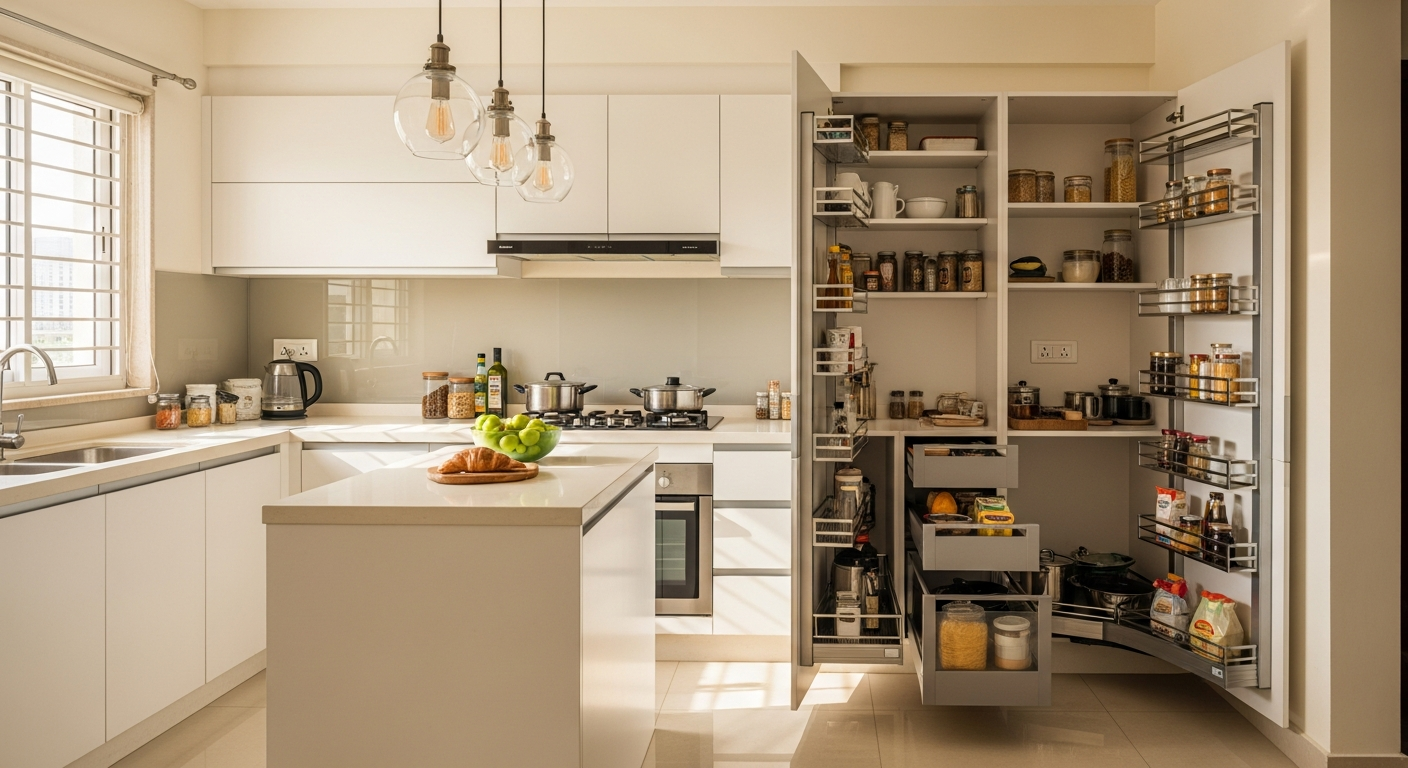
The most consistent complaint from Bangalore homeowners about their kitchens — regardless of size — is insufficient storage. In compact flats, this problem is acute: a 2BHK kitchen of 60–90 sq ft must store everything a household cooks with, while also maintaining clear counter space for actual cooking. The good news is that a well-designed modular kitchen can store considerably more than a poorly planned one of twice the size. Here's how.
Tall Units: The Biggest Storage Win
Standard modular kitchen configurations place upper cabinets at a height that leaves a gap between the top of the cabinets and the ceiling. In a compact kitchen, this space above the upper cabinets is the single largest untapped storage zone — typically 300–400mm of depth and the full width of the kitchen run.
A tall unit configuration — where upper cabinets extend from counter height to ceiling — eliminates this wasted zone entirely. In practical terms, the upper tier (above the standard upper cabinet height) accommodates large serving dishes, seasonal appliances (stand mixer, waffle iron), pressure cookers used monthly rather than daily, and bulky storage containers. These items are retrieved infrequently enough that the need to use a step stool is not a daily inconvenience.
In a 2BHK kitchen, specifying ceiling-height upper cabinets across the full kitchen run can increase upper storage capacity by 35–40% at modest additional cost. It is the highest-return storage investment in any compact kitchen.
Corner Solutions: The Dead Zone Problem
An L-shaped or U-shaped kitchen creates corner zones where two runs of cabinets meet. These corners are the most problematic storage areas in any kitchen — deep, dark, and often functionally inaccessible with standard shelf configurations. Items pushed to the back of a corner shelf are forgotten, then discovered months later. This is not a user failure — it's a design failure.
Bottle-pull carousel (for blind corners): A carousel mechanism mounted inside the corner cabinet brings items out to the front when the door is opened, then rotates back in. Items are always visible and accessible. The mechanism adds cost, but the functional improvement is substantial and the corner cabinet becomes genuinely usable rather than a storage dead zone.
Magic corner (for L-shaped junctions): A magic corner unit uses a two-tier tray mechanism that slides out from the side of the adjacent cabinet, bringing the corner contents forward. It makes the full depth of the corner accessible without reaching. This is the appropriate solution where the corner meets a walkway rather than a wall.
No-corner approach: In very compact kitchens where corner mechanism cost is a constraint, design out the problematic corner entirely by using a flat appliance bay or open shelf in the corner zone. An open shelf in the corner is used for daily-use items (oil, salt, frequently needed spices) and eliminates the accessibility problem through openness rather than mechanism.
Pull-Out Organisers: Transform the Lower Cabinets
The most under-used storage zones in most kitchens are the lower cabinets — specifically the ones that are simply shelved with no organisational structure. A lower cabinet with two fixed shelves requires bending, reaching, and unstacking to access anything at the back. This inconvenience is not trivial — it means the front 200mm of the cabinet gets used repeatedly and the remaining 400mm of depth is effectively dead storage.
Deep drawer modules: Where possible, replace lower cabinets with deep drawer modules. A deep drawer pulls fully out to reveal its entire contents at once. Pots, pans, lids, and storage containers are visible and accessible without bending or reaching. Three deep drawers in a lower 900mm wide module store more usable items than two shelved cabinets of the same width.
Cutlery drawer insert: Specify a cutlery tray insert in the drawer closest to the cooking position. This organises the most frequently accessed kitchen items — every utensil has a defined space, items don't pile up, and the drawer doesn't need emptying to find what you're looking for. This is a modest addition at the design stage that transforms the daily kitchen experience.
Plate and thali pull-out: A vertical plate organiser in a narrow lower module (300–450mm wide) stores plates, thalis, and chopping boards vertically rather than in a horizontal stack. Access is instant — plates slide forward without disturbing others — and breakage from unstacking is eliminated.
Wall Cabinet Optimisation
The space between the counter and the bottom of the upper cabinets — typically 450–600mm of backsplash area — is often used purely decoratively. In a compact kitchen, it can hold more functional storage without the cost of additional cabinets.
Rail system: A horizontal rail mounted on the backsplash holds hooks, containers, a paper towel holder, and small baskets for frequently used items (spices, small utensils, oil and vinegar containers). This keeps frequently accessed items within arm's reach while keeping the counter clear.
Magnetic strip: A magnetic knife strip mounted on the backsplash stores knives safely, accessibly, and without taking drawer space. In a compact kitchen, every drawer freed from knife storage is a drawer available for something else.
Under-Sink Utilisation
The under-sink cabinet is typically configured as an open shelved space that accommodates the plumbing pipe and leaves the remaining area cluttered with cleaning supplies. In a compact kitchen, this space deserves a designed organisation system rather than an afterthought.
A pull-out organisation tray under the sink — designed around the pipe profile — stores cleaning liquids, dishwasher tablets, scrubbing supplies, and spare trash bags in accessible, organised positions. A separate bin pull-out unit (single or dual compartment for waste and recycling) under the sink or in the adjacent lower cabinet keeps the bin off the floor and accessible without visible clutter.
Counter Management
Clear counter space is the metric of a well-designed compact kitchen. Every appliance that sits permanently on the counter occupies working surface and makes the kitchen feel smaller. The design question is: which appliances are used daily and must remain out, and which can be stored in a tall appliance bay with a tambour shutter or deep lower drawer?
For most Indian households, the microwave and the electric kettle are permanent counter residents — daily use justifies their permanent position. The mixer-grinder is used 3–5 times per week and should be stored in a pull-out appliance drawer with a dedicated outlet inside the cabinet. The toaster, juicer, and air fryer are occasional-use appliances and belong in the tall unit's appliance zone.
Designing specific, dimensioned storage for each appliance — rather than a generic tall cabinet where everything gets piled — is the difference between a kitchen that stays organised and one that reverts to clutter within months.
Want a compact kitchen designed for maximum storage and effortless use?
Frequently Asked Questions
A single-wall kitchen (sometimes called a straight or parallel-single layout) benefits most from: full-height upper cabinets from floor to ceiling (eliminating the dead space above standard-height upper cabinets), a tall pantry tower at one end for bulk storage, deep lower drawers for pots and pans instead of shelved cabinets, and magnetic or rail-based wall storage on the adjacent wall for frequently used utensils and spice containers. Even in a single-wall kitchen, a well-planned modular layout can store significantly more than a poorly planned larger kitchen.
Yes — for specific modules. The highest-value pull-out investments are: a bottle-pull carousel in the blind corner (eliminates an otherwise inaccessible dead zone), a cutlery drawer organiser (transforms the most-used drawer in the kitchen), and a plate or thali pull-out in the lower cabinets (replacing a standard shelved cabinet). These are not luxury additions — they are functional upgrades that change how you use the kitchen daily. Specifying them at the design stage costs less than retrofitting them later.
Standard upper wall cabinets are typically 600–720mm tall, leaving a gap to the ceiling that becomes a dust trap. In a compact kitchen, specify upper cabinets that run to the ceiling height (or to the false ceiling soffit, if one exists). This can be achieved with a second tier of shallower cabinets above the standard upper cabinets — used for seasonal items, large serving dishes, and rarely-used appliances. Ceiling-height upper cabinets can increase upper storage capacity by 30–40% without changing the kitchen footprint.