Most interior design conversations focus on aesthetics. For growing families in Bangalore, the more pressing questions are about durability, adaptability, safety, and storage. A home that looks beautiful on day one but can't survive daily family life is a design failure — regardless of how it photographs. This guide focuses on what actually matters when you're designing a home for the next five to ten years of family living.
Design for the Next Five Years, Not Just Today
A 2-year-old who currently uses a corner of the living room as a play area will be a 7-year-old who needs a desk, a bookshelf, and organised stationery storage. A family that currently cooks for three will be cooking for four or five. The guest room that hosts occasional visitors will become a teenager's bedroom in four years.
The best family interiors are designed with this forward thinking built in: wardrobes with adjustable shelf heights rather than fixed configurations, a children's room that has the plumbing and space for a future study unit, a kitchen that can absorb a second cook without workflow conflicts. These choices cost nothing extra at the design stage. They cost significantly more as retrofits.
When briefing your designer, think room-by-room: what does this room need to do now, and what should it still be able to do in five years? This single question produces better design decisions than any reference Pinterest board.
Child Safety in Design Choices
Child safety manifests in several specific material and design decisions that are easy to address at the planning stage and difficult to change afterwards.
Sharp corners: Standard furniture and cabinet corners are a genuine hazard for toddlers and young children. All fixed furniture — TV units, wardrobes, kitchen lower cabinets — should be specified with radius corners (minimum 8mm) rather than sharp 90° profiles. This is a design specification, not an afterthought add-on, and costs nothing if specified upfront.
Hardware type: Soft-close mechanisms on every shutter and drawer are not just a convenience for adults — they prevent pinched fingers and slammed doors. In a household with young children, the finger-protection argument alone justifies the upgrade.
Floor materials: Large-format vitrified tiles with a matte or satin finish are safer than highly polished tiles, which become slippery when wet. Anti-skid ratings matter particularly in bathrooms and kitchen areas where children move quickly on wet floors.
Accessible storage heights: Design children's rooms with lower shelves and accessible drawer heights so children can reach and organise their own belongings independently. Wardrobes that force children to reach above their heads for frequently used items encourage pulling on shelves — a safety and durability issue.
Durability Over Aesthetics — Where It Matters
Not every surface in a family home needs to be treated with the same durability specification. The kitchen countertop and the children's bedroom wall are very different use cases.
Kitchen countertop: Quartz is the correct choice for an active family kitchen. It is non-porous (no staining from turmeric, oil, or acids), does not require periodic sealing, and is available in formats and colours that work with virtually any kitchen palette. The durability premium over granite is meaningfully expressed over a 10–15 year kitchen lifespan in a family that cooks daily.
Wall paint: Children's rooms and corridors warrant washable premium emulsion — not because of the quality of the paint finish visually, but because washable formulations can handle crayon marks, handprints, and general child-height contact without requiring a full repaint every two years. Specify scrubbable emulsion in all rooms below the first floor's resident height of damage.
Wardrobe interiors: Particleboard carcases with laminate interiors are fine. What matters most for a family wardrobe is the internal organisation layout — specifically, adequate drawer sections, lower-height accessible zones for children's clothing, and loft sections for seasonal or infrequently accessed items. A well-organised wardrobe reduces the morning chaos that families know intimately.
Room-by-Room Priorities for a Family Home
Kitchen: The kitchen runs the household. Invest in a functional layout first (workflow triangle or zone layout), generous counter space, ample storage including a tall pantry unit, and durable surfaces. For families with older parents or grandparents, accessible lower cabinet heights and pull-out drawers reduce bending strain.
Children's bedroom: Flexibility and storage. A study unit that accommodates age changes, ample wardrobe space, and a layout that doesn't require repositioning furniture as the child grows. Avoid ceiling treatments that make the room feel closed or low — children's rooms benefit from light and perceived space.
Master bedroom: This is the parents' recovery space. Invest in the wardrobe — a well-designed master wardrobe with proper organisation transforms the morning routine. Keep the master bedroom free of TV units and work desks if possible; it is a rest space, and families that protect it as such benefit significantly.
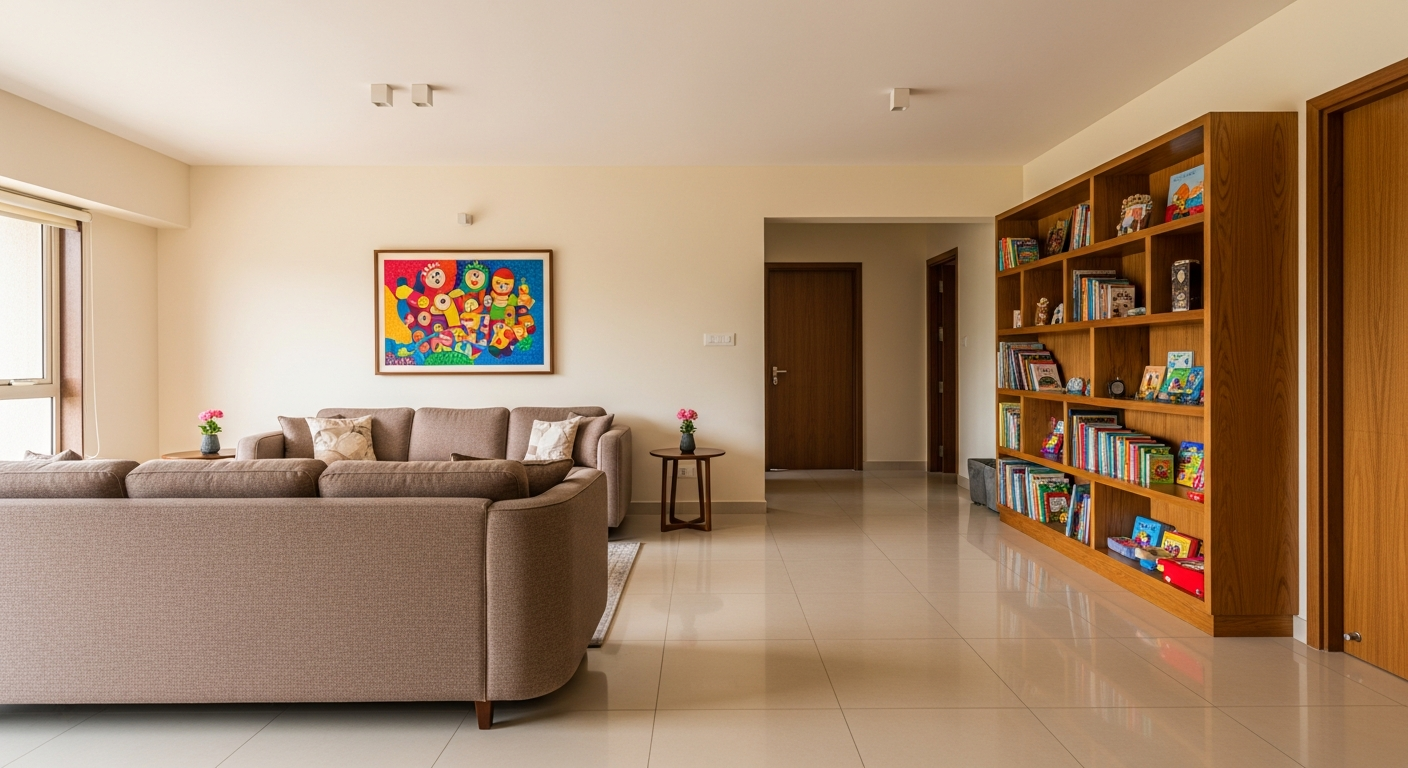
Living and dining: In a family home, these spaces handle homework, guests, family meals, and weekend gathering simultaneously. The dining table should be sized generously (not the smallest table that fits). The living room should have clear traffic flow and accessible storage for everyday family items — books, charging stations, game boxes — without cluttering the visual space.
Storage: Never Enough, Always Underplanned
The most consistent feedback from families one year after moving into their completed home is: "We should have added more storage." The kitchen never has enough pantry space. The children's rooms overflow within six months. The master bedroom wardrobe is inadequate by year two as the household accumulates.
At the brief stage, add 25% to whatever storage you think you need. That correction will still not be enough — but it will be better. Specifically: tall pantry cabinets in the kitchen (floor-to-ceiling, not just above the refrigerator), loft storage in every bedroom wardrobe, a dedicated dedicated utility storage area, and at least one storage unit in the living area that accommodates the items families actually live with every day.
Why the Premium Tier Is the Family Sweet Spot
The Premium tier — acrylic or matte kitchen, soft-close hardware, quartz countertop, cove ceiling in living areas, well-organised wardrobes — delivers everything that matters for daily family life without over-speccing on elements that don't affect how the home actually functions. The Essential tier may leave families wanting in durability and organisation. The Elite tier is appropriately reserved for larger properties with different expectations.
For most Bangalore families in a 3BHK, the Premium tier with a storage-first brief is the correct specification. It produces a home that is beautiful, durable, well-organised, and genuinely suited to the way families live.
Ready to design a home built for the way your family actually lives?
Frequently Asked Questions
Matte acrylic or matte laminate finishes are the most practical for households with young children. Gloss finishes show fingerprints immediately and scratch visibly when wiped with abrasive cloths. Quartz countertops are the most child-friendly surface for the cooking area — non-porous, non-staining, and easy to clean after anything from turmeric to paint. Avoid natural marble countertops in a working family kitchen; they are porous and require careful maintenance.
Yes. A children's room needs to serve multiple functions across a changing age range: a play area now, a study zone in a few years, and a teenage retreat later. The most adaptable approach is a flexible layout with ample wardrobe and storage, a study unit that can grow with the child (adjustable shelves, a proper desk surface), and finish materials that are easy to clean and repaint. Avoid over-theming the room — what a 4-year-old loves and what a 10-year-old wants are very different.
An up-to-15-year warranty on modular work means that hardware failures, shutter delamination, or carcase issues within the warranty period are resolved without additional cost. For a family that is actively using the kitchen, wardrobes, and storage every day, this protection is meaningful — it eliminates the anxiety of a hardware failure causing an expensive repair call in year four or year six. The warranty is only as valuable as the company behind it, which is why choosing an established firm with a permanent business address matters.