The living room ceiling is the largest uninterrupted horizontal surface in your home — and most Bangalore apartments leave it completely bare. A well-chosen false ceiling design changes not just how the room looks but how it feels. Light bounces differently, zones are defined, and the space acquires a sense of architectural completion that no amount of furniture can replicate.
We've categorised fifteen designs across three complexity levels to help you identify what's right for your living room size and tier. All are based on designs we've actually executed across our Bangalore project portfolio.
Simple Designs — Best for Compact Living Rooms Under 150 sq ft
These five designs work in any room, require minimal ceiling height sacrifice, and deliver reliable results. They're the right choice for 2BHK and most 3BHK living rooms.
1. Peripheral Cove Border — The most reliable design in our portfolio. A continuous cove channel runs along the perimeter of the ceiling, housing a warm LED strip. Light bounces off the ceiling surface, filling the room with soft, indirect illumination. Simple, elegant, and impossible to get wrong. Works in 9ft ceilings and above.
2. Rectangular Central Drop — A flat rectangular panel drops slightly lower than the surrounding ceiling over the central seating area. Recessed downlights are positioned within the dropped panel. Creates visual focus without complexity. Best when the seating arrangement is centred in the room.
3. L-Shaped Cove Along Two Walls — Rather than a full perimeter, the cove follows only two adjacent walls. This asymmetric treatment creates an interesting directional light effect and works well in rooms where one wall is the TV wall and the other is a window wall.
4. Slim Floating Panel Above TV Wall — A flat rectangular panel aligned directly above the TV unit and feature wall. This design zones the TV area without affecting the rest of the ceiling. Especially effective when combined with panel backlighting that transitions from ceiling to wall.
5. Minimal Perimeter with Pendant Provision — For clients who prefer pendants or chandeliers, a simple perimeter cove with a ceiling rose provision at the centre. The pendant does the decorative work; the cove provides ambient fill light.
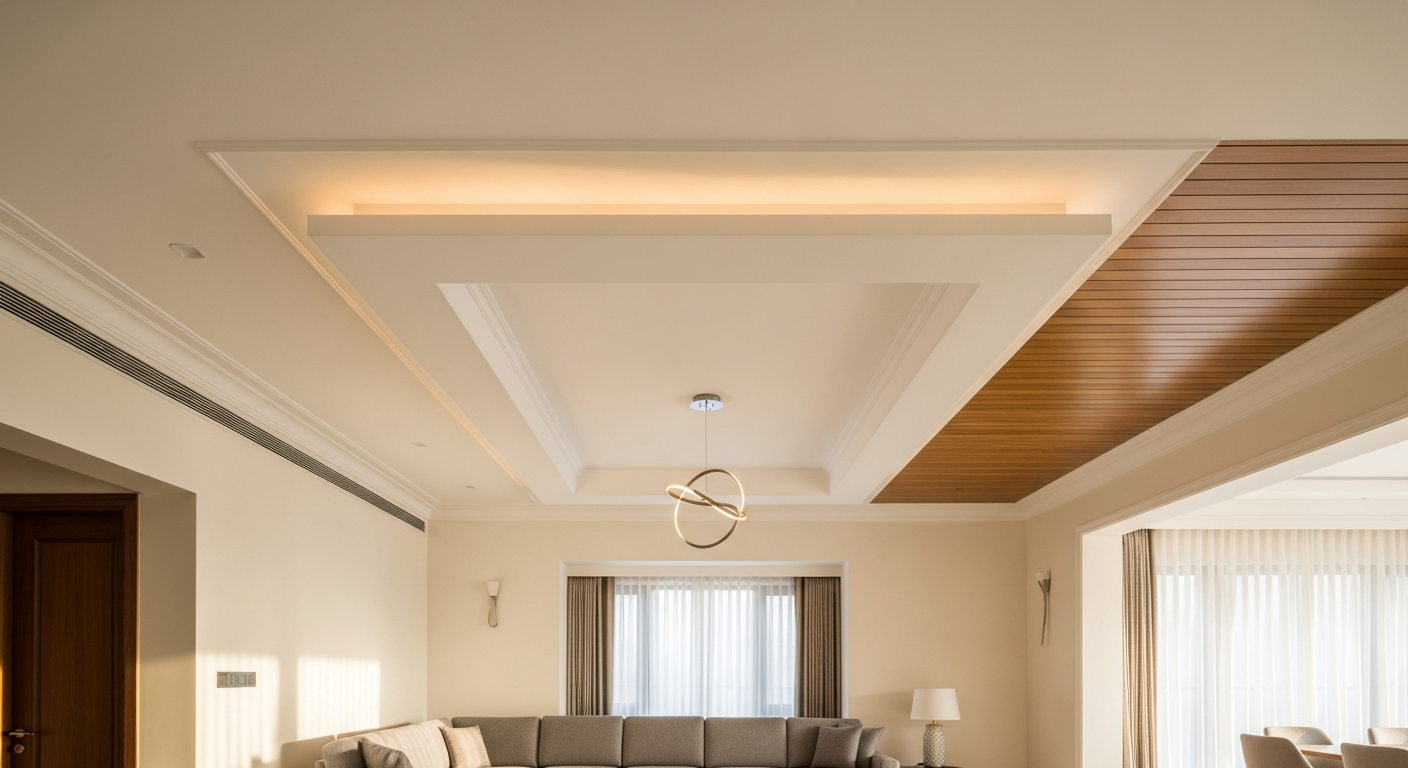
A dual-level ceiling with peripheral cove and a dropped accent panel creates visual depth in a 3BHK living room.
Medium Complexity Designs — Best for Spacious 3BHK and 4BHK Living Rooms
These designs require 10ft ceiling height minimum and a floor area of 150–250 sq ft. They introduce layering and zoning that elevate a standard apartment living room to something genuinely designed.
6. Cove + Accent Combination — A peripheral cove for ambient light combined with a separate rectangular accent panel over the main seating zone. Two ceiling levels, two lighting moods. The most popular design in our 3BHK projects.
7. Dual-Level Step Ceiling — The ceiling steps down in two levels from the perimeter toward the centre. Creates dramatic depth and shadow. Lighting is integrated into each step. Works in rectangular rooms where the levels can follow the room geometry cleanly.
8. Curved Cove — Instead of straight rectangular channels, the cove follows a curved path — either a central oval or curved perimeter corners. Softens the rigid geometry of a rectangular room. Best for clients whose furniture choices also tend toward rounded forms.
9. Back-Lit Panel Above TV Wall Connecting to Ceiling — The TV wall feature panel extends upward and transitions into a ceiling panel, creating a seamless surface from wall to ceiling. LED backlighting runs along the join. Creates one of the most contemporary, sophisticated effects possible in a 3BHK living room.
10. Zoned Cove with Recessed Lighting Arrangement — Rather than a single cove zone, the ceiling is divided into two areas — a seating zone and a dining/entry zone — each with its own lighting level. This works especially well in open-plan living rooms where the floor plan is L-shaped or the dining is adjacent.
Premium Designs — Best for 4BHK, Villa, and Penthouse Living Rooms
These five designs require 10–11ft+ ceiling height, more construction time, and skilled execution. They're the right choice when the living room is 250 sq ft or larger, and when the design brief calls for something truly architectural.
11. Multi-Layer Ceiling with Dimmer Zones — Three or more ceiling levels, each independently dimmable. The room can shift from a bright gathering space to a soft, intimate evening atmosphere with one switch. Requires careful lighting design planning at the drawing stage.
12. Wooden Ceiling Accent Panel — A central section or partial ceiling panel finished in natural wood or high-quality wood-finish laminate. Introduces warmth and texture that no paint or gypsum treatment can replicate. Best used as a ceiling island above the sofa zone rather than across the entire ceiling.
13. Integrated Ceiling with Concealed AC Ducting — In larger homes, the AC units are ducted and concealed within the false ceiling structure rather than surface-mounted. This requires deeper false ceiling construction but results in a completely clean ceiling surface — no visible units, no grilles interrupting the design.
14. Continuous Ceiling-to-Wall Treatment — The ceiling design flows down the TV wall in a single uninterrupted composition. The cove transitions into a wall panel treatment, dissolving the boundary between ceiling and wall. This is the treatment most commonly associated with premium villa and penthouse living rooms.
15. Coffered or Geometric Pattern Ceiling — A grid of recessed rectangular panels (coffered) or geometric patterns routed into the gypsum surface. A classic architectural treatment that suits homes with formal aesthetics — Mughal-inspired design, traditional Kerala architecture updates, or contemporary formal dining arrangements.
Choosing the Right Design for Your Space
The decision tree is simpler than it appears. Under 150 sq ft living room: designs 1–5 are your range. 150–250 sq ft: designs 6–10 are appropriate. Over 250 sq ft or a double-height living room: designs 11–15 are within scope.
Ceiling height is the hard constraint. For multi-level designs, you need at least 10 feet before false ceiling work begins. Most standard Bangalore apartment slab heights are 9.5–10 feet, which allows for one level of false ceiling at 9 feet finished. For two-level designs, you need the slab at 10 feet minimum.
Lighting Is Where the Design Lives or Dies
A false ceiling design is only as good as the LED quality installed within it. Cheap LED strips dim unevenly, develop hot spots, and fail within two years. The warm glow of a well-lit cove ceiling depends entirely on consistent, high-quality LEDs running at the right colour temperature.
For living room coves, warm white LEDs at 3000K create the evening-glow effect that makes a space feel genuinely comfortable. For task lighting over dining or reading zones, neutral 4000K LEDs provide clarity without harshness. Dimmable circuits — slightly more expensive to wire — give you full control over the mood of your living room for different times of day.
Our guide to false ceiling types explains material choices in detail. For lighting specifically, our cove vs recessed lighting article covers when to use each approach.
If you're planning a 4BHK interior design or larger, budgeting for a multi-level design with quality LEDs is one of the best investments you can make in the visual impact of your home.
Want the Right Ceiling Design for Your Living Room?
Our design team will assess your ceiling height, room dimensions, and design brief to recommend the right false ceiling approach for your home and budget.
Frequently Asked Questions
The simple peripheral cove border with warm LED strip lighting. It works in any room size, suits any budget tier, and universally transforms a builder-grade ceiling into a designed space. It's our most-executed ceiling design across 1200+ projects. If you're unsure what to choose, start here — it rarely disappoints.
Yes, and we recommend it. The living room receives the most complex treatment since it's the most-viewed space. Bedrooms work best with simpler cove borders or no false ceiling at all to preserve height. The kitchen false ceiling is typically functional — housing the chimney flue and recessed lights — rather than decorative.
A simple peripheral cove border typically reduces ceiling height by 6–8 inches. A multi-level design with AC ducting integration can reduce height by 9–14 inches. For comfortable living rooms, we recommend a minimum finished ceiling height of 9 feet after false ceiling installation. This is achievable in most Bangalore apartments built after 2015.