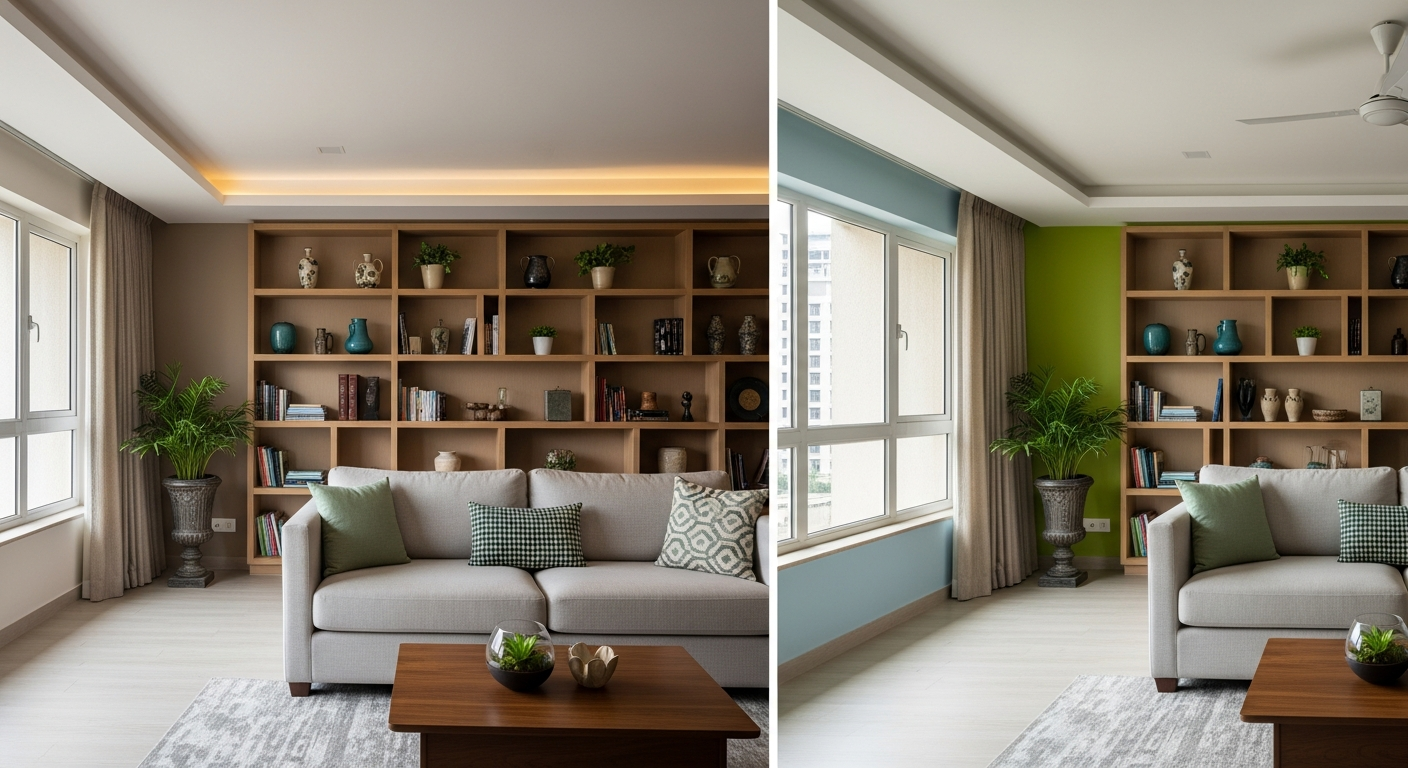
After completing interiors for 1200+ homes in Bangalore, patterns emerge. Not just in design preferences or material choices — but in the mistakes that homeowners repeatedly make, and the regrets they share during or after the project. Most of these mistakes are entirely avoidable. Here are the six most common ones, and what to do instead.
Mistake 1: Using the Lowest Quote as the Decision Criterion
This is the most common and most expensive mistake in Bangalore's interior market. When three designers present widely different quotes for "the same thing," the temptation is to read the lowest number as the best deal. But the quotes are almost never for the same thing — they differ in scope, material grade, warranty, and execution quality in ways that aren't immediately visible.
A quote that appears 30% cheaper than competitors typically achieves it through one or more of: fewer rooms in scope, cheaper materials (unbranded laminates, standard hardware), shorter or no warranty, no dedicated project manager, on-site fabrication instead of factory-finish carpentry, or exclusions that will appear as extras later. Read the hidden costs guide to understand what commonly goes missing from low quotes.
The right approach: compare proposals by scope, material specification, warranty, and process — then compare price. See the designer evaluation guide for a structured framework.
Mistake 2: Ignoring the Brief, Trusting Vibes
Many homeowners enter the design process without a written brief — and rely on the designer to "understand" their needs from conversation and a few reference images. This works sometimes. It fails badly when the homeowner and designer have different implicit assumptions about priorities.
A brief doesn't need to be elaborate. It needs to answer: who lives in this home and how, what are the non-negotiable functional requirements (storage, study space, pooja room, guest accommodation), what's the style direction, and what's the firm budget. Getting these answers written down before meeting a designer produces dramatically better outcomes than trying to communicate them verbally across multiple conversations. Our designer briefing guide walks through exactly what to put in a brief.
Mistake 3: Rushing or Skipping the 3D Visualisation Review
3D visualisation is not a formality. It's the single point in the project where you can see your home before anything is built — and make changes at zero cost. A wardrobe placement that felt right on a floor plan looks wrong in 3D. A ceiling treatment that sounded good in a meeting reveals its scale issues when rendered. A colour palette that seemed balanced in material samples interacts unexpectedly with the actual room dimensions and light.
Every change made at the 3D stage costs nothing. Every change made after production begins adds cost and delay. Every change made after installation is complete is largely irreversible at any reasonable cost. Treat the 3D review as the most important decision gate in the project — not a rubber stamp.
3D review is where you spend 30 minutes to prevent 3 weeks of rework — treat it seriously.
Mistake 4: Underestimating the Budget
Most first-time homeowners significantly underestimate what an interior project costs — and many make this mistake after speaking with contractors who gave them a number that turned out to be incomplete. The consequences: scope is cut mid-project (rooms get dropped, finishes get downgraded), or the original budget is blown through uncontrolled additions, or the project stalls when money runs out before completion.
A complete interior project for a 3BHK in Bangalore covers kitchen, wardrobes in all bedrooms, TV unit and living room feature, false ceiling throughout, flooring, painting, fixed furniture, and all loose furniture. Setting a realistic budget before starting means building in a 10–15% contingency buffer for decisions that change after scoping — it almost always gets used.
Our interior budget guide gives a realistic starting framework for different property sizes and finish tiers.
Mistake 5: Not Accounting for the Living-Through-Work Period
Many Bangalore homeowners underestimate the disruption of an interior project — and don't plan for where they'll stay or how they'll manage if they're living in the flat during work. Site execution generates dust, noise, and blocked access to kitchens, bedrooms, and bathrooms in sequence.
For a full-scope 3BHK, plan for 6–8 weeks where the flat is substantially uninhabitable. Families who try to live in the flat during full-scope execution face daily disruption, create safety concerns on site, slow the work by limiting access, and introduce the risk of damage to completed sections. Budget the cost of temporary accommodation as part of the project — it's a real project cost.
Mistake 6: Making Major Changes After Production Starts
Once the BOQ is signed and production begins, changes are expensive. Not because designers charge arbitrarily for revisions — but because production is a sequential, scheduled process. A kitchen that's already been cut and machined cannot be resized without significant material waste and re-scheduling. A wardrobe whose carcasses are already assembled requires the same.
The place to make changes is in the design phase — specifically before the BOQ sign-off. That moment is the design freeze. Changes before it are design decisions. Changes after it are variations with real costs. The 3D visualisation and BOQ review stages exist precisely to create a moment where every decision can be examined before it becomes irreversible.
For a full picture of how a well-run project structures these gates, see the week-by-week project timeline. Understanding the sequence makes it clear why certain decisions must be made at certain stages — and why changing your mind later carries real consequences.
Start Right, Finish Strong
Our process is structured to prevent exactly these mistakes. Book a free consultation to see how we work.
Frequently Asked Questions
Choosing a contractor based on the lowest quote without understanding why the quote is lower than others. The gap is almost always in scope (fewer rooms, fewer items, cheaper materials, no 3D), warranty (none or short-term), or execution (no project manager, no quality control). The cost of correcting poor workmanship — hacking out incorrectly installed cabinetry, repainting walls after substandard painting, replacing hardware that fails within a year — typically exceeds what was saved in the original decision.
Not if you do it with the designer's input. The mistake is buying furniture before the space plan is finalised — dimensions that look fine in a showroom can overwhelm a room or block circulation paths when placed in an actual layout. Bring dimensions from your finalised floor plan to any furniture shopping. Better still, share your designer's layout with the furniture store — a good salesperson will work with it rather than ignore it.
Lock scope before production begins and hold the line on changes once work starts. Every mid-project addition — 'can we just add a small study unit here,' 'actually can we do that room too' — carries a cost beyond the item price: it disrupts production schedules, delays already-in-progress work, and often requires re-engineering decisions that were made assuming the original scope. A clear pre-production BOQ sign-off is the most effective prevention.